
 ParticipantsReady
We’re going to Web Summit. Lisbon, 10 to 12 November. We spent a rainy Sunday afternoon before the conference digging into the data, because graphs are fun and we were bored. If you’re there and you want to talk about data, book a slot or find me in the Web Summit app. I’m the one with the dataset.
Find Paul in the Web Summit app
Connect on LinkedIn
Web Summit is a conference about data, among other things, and it publishes a lot of it: every attendee who opts into the directory, every exhibiting startup, every session on every stage. Nobody reads it, because it’s 22,000 profile cards behind a search box. And despite being a tech conference in 2026, Web Summit doesn’t have an MCP server. If it did, we wouldn’t have had to do any of this. So before we booked a single meeting, we asked Jason, our AI data engineer, to read the whole thing and turn it into three tables we could actually use.
That was the entire brief. One Slack message on a Friday morning, three datasets by lunch.
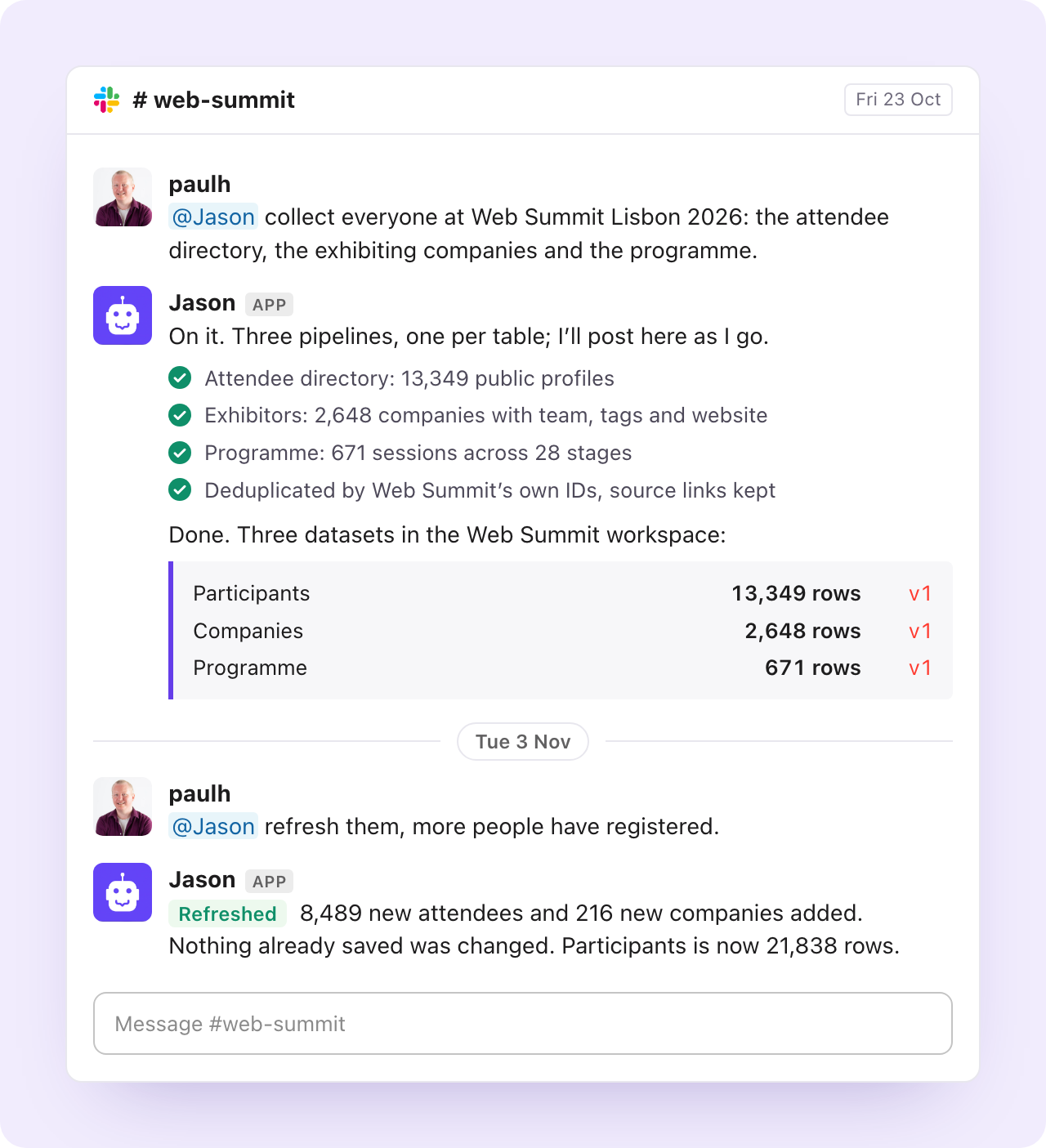
This post is what we found. The methodology is at the end, including what we didn’t collect and what we’re not publishing.
Eleven days later
The first run on 23 October gave us 13,349 attendee profiles, 2,648 companies and 671 sessions. Then registrations kept coming, and on 3 November the message was just “refresh them”. Jason read the directory again, matched every profile on Web Summit’s own ID, and added 8,489 new attendees and 216 new companies. The 13,349 rows from the first run were not touched: every one of them still carries its 23 October timestamp. The programme is replaced whole on each run, by design, because sessions move.
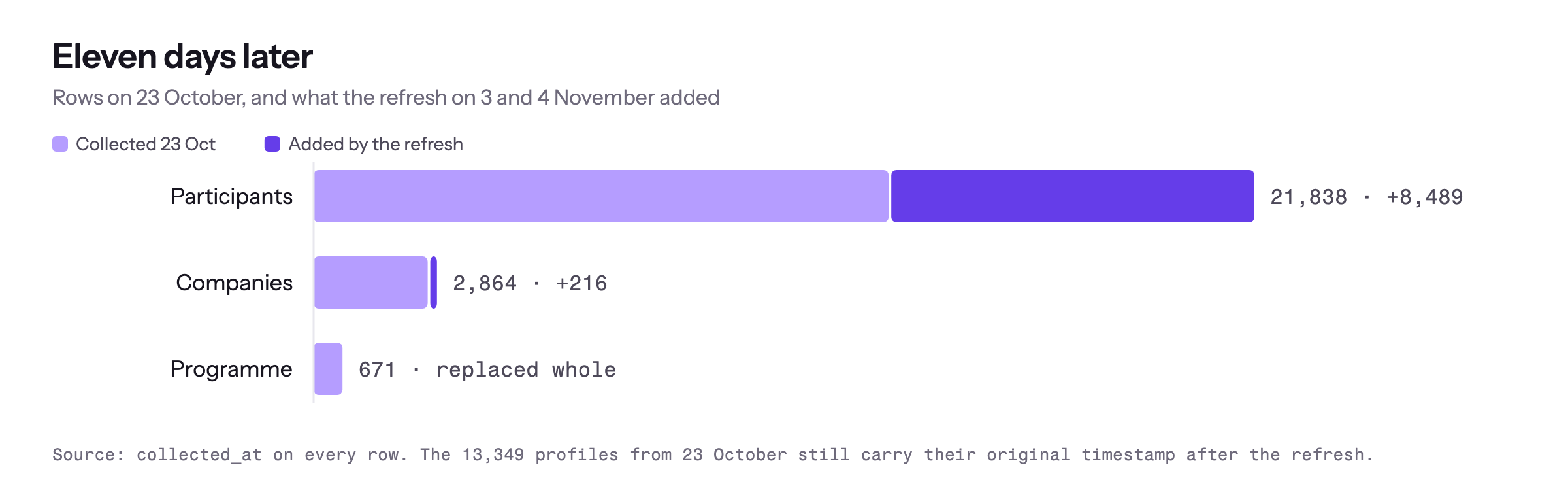
That is the part a weekend scraper cannot do. Anyone can pull a directory once. The second run, eleven days later, is where self-built collectors die: the pagination has shifted, half the rows come back as duplicates and the other half overwrite the ones you had. Jason’s pipeline carries that as a rule, in its own words: “Discover all available records by default, fetch details only for new identities, and retain all previously saved records unchanged.” The refresh took one message and no code.
The crowd
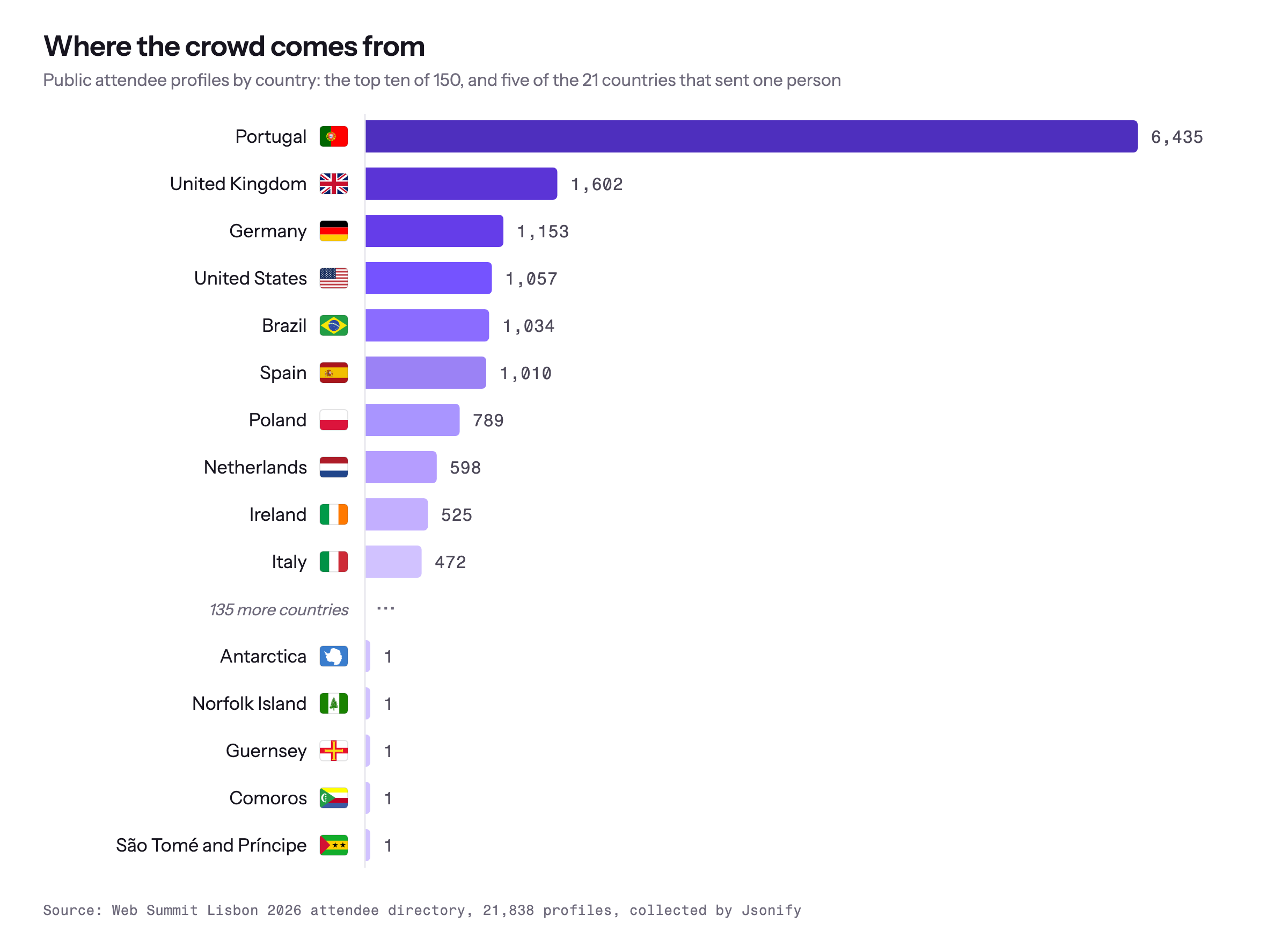
The public directory had 21,838 attendee profiles when we last refreshed it, from 150 countries. It’s a Portuguese event with an international layer on top: 29% of profiles are from Portugal, and the UK, Germany, the US and Brazil follow with around 1,000 to 1,600 each.
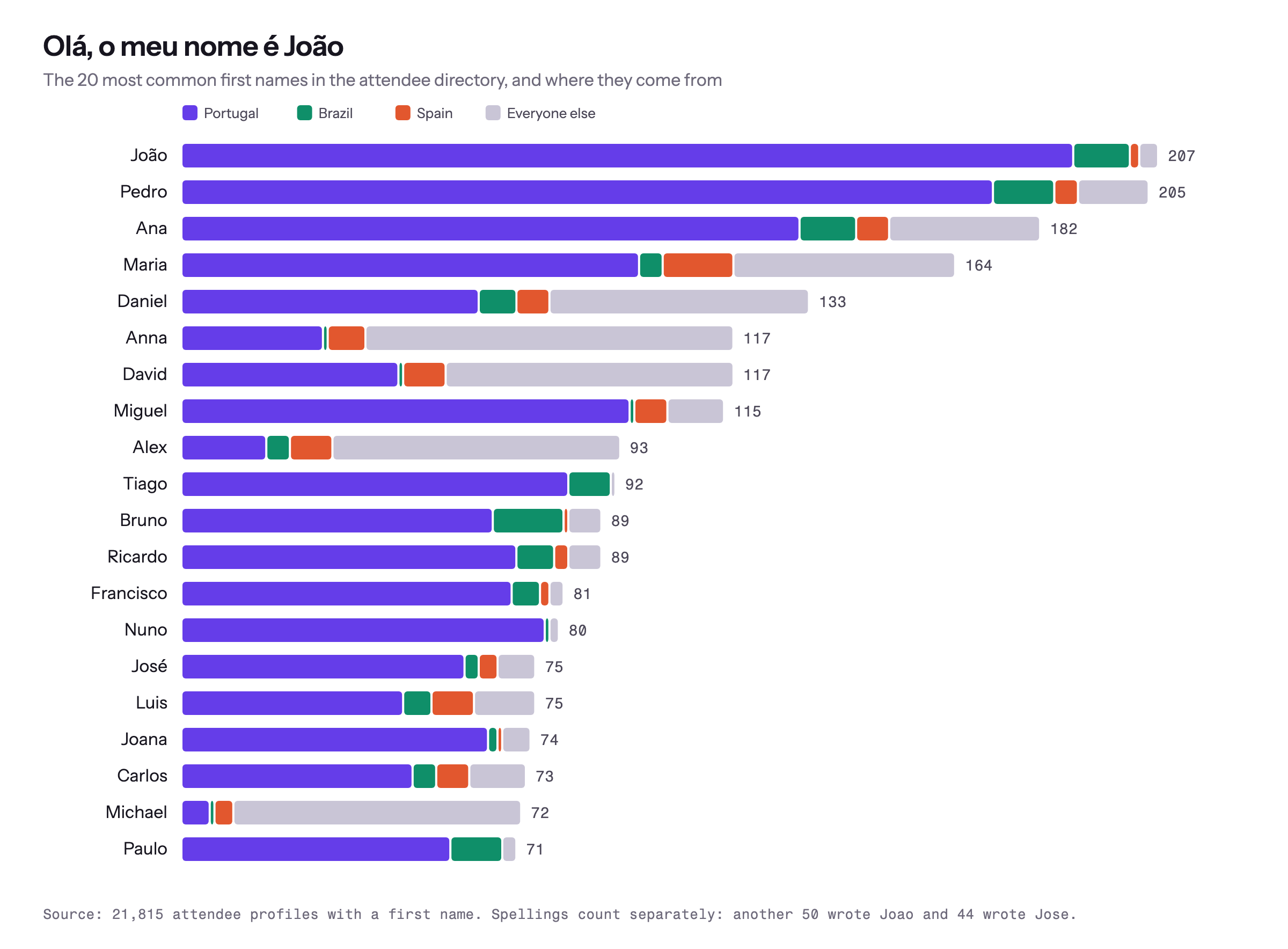
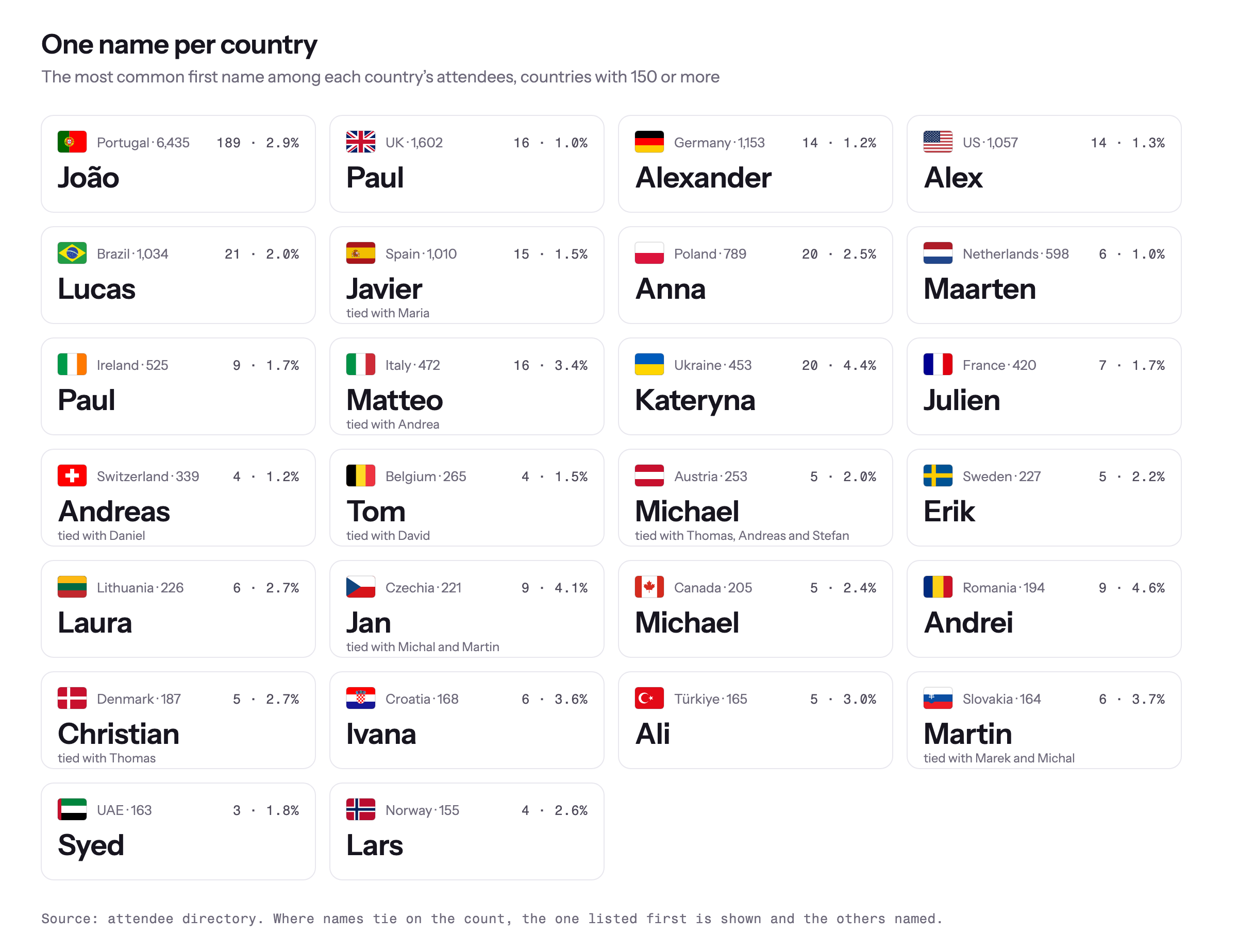
It shows in the first names. João is the most common first name in the room (207), one ahead of Pedro (205). Ana and Maria complete the top four before you reach a Daniel.
Widen it to one name per country and the list changes completely. Brazil sends Lucas, Ukraine sends Kateryna, Italy is split between Matteo and Andrea. The most common first name among British attendees is Paul, and it is Paul in Ireland too. There are 25 of us. If you’re looking for me, that narrows it down less than you’d hope.
At the other end, 21 countries have exactly one attendee in the directory, from Uganda to Paraguay to Guernsey, and one profile lists Antarctica as its country. Two list North Korea. 56 of the 150 countries have five people or fewer.
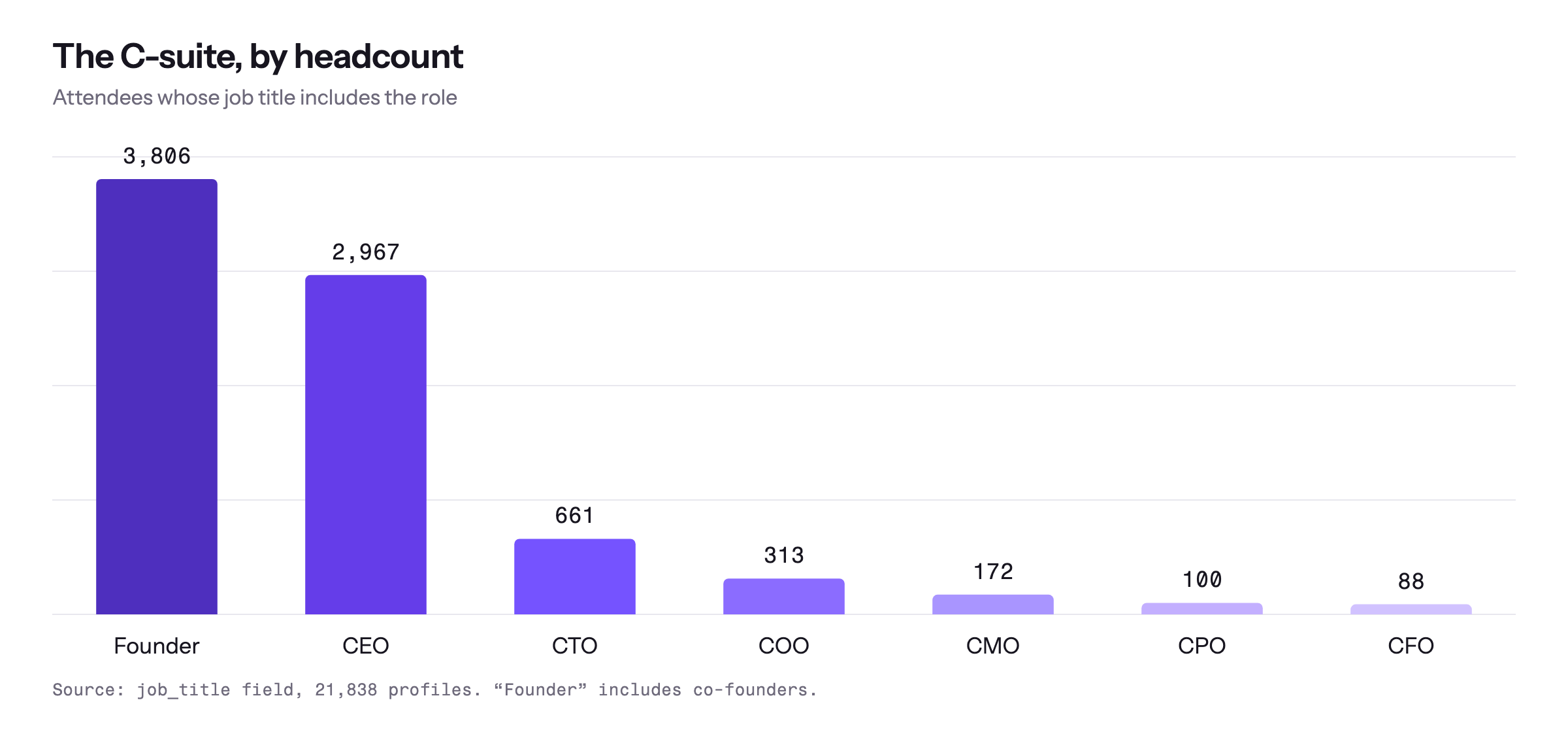
Now the job titles. There are 3,806 founders and 2,967 CEOs. There are 88 CFOs. That is roughly 34 CEOs for every CFO, which is either a statement about who gets sent to conferences or about who is doing the accounts.
Below the C-suite, who gets sent changes with the passport. We sorted every job title that fitted either list into technical (engineering, product, data, design) or commercial (sales, marketing, business development, partnerships), left the founders and CEOs out, and compared countries. Austria and Portugal send four technical people for every commercial one. The United States is the only country that sends more sellers than builders. The UK, France and Spain sit in between at roughly four to three.
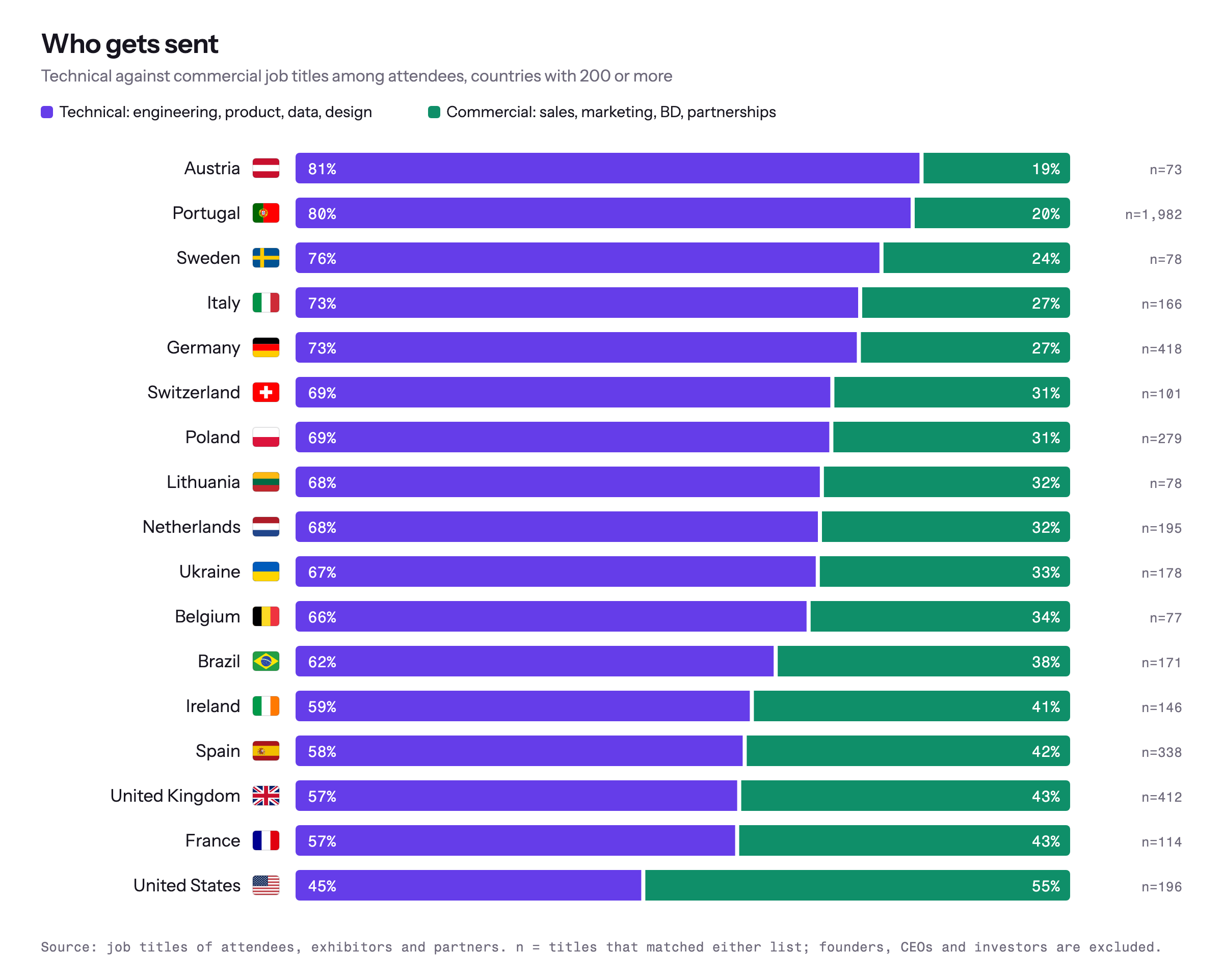
Our reading, and it is only a reading: the countries that send engineers are here to look at tooling, and the countries that send sales teams are here to sell it. If you’re pitching an American stand this week, expect to be asked for the business case before the demo.
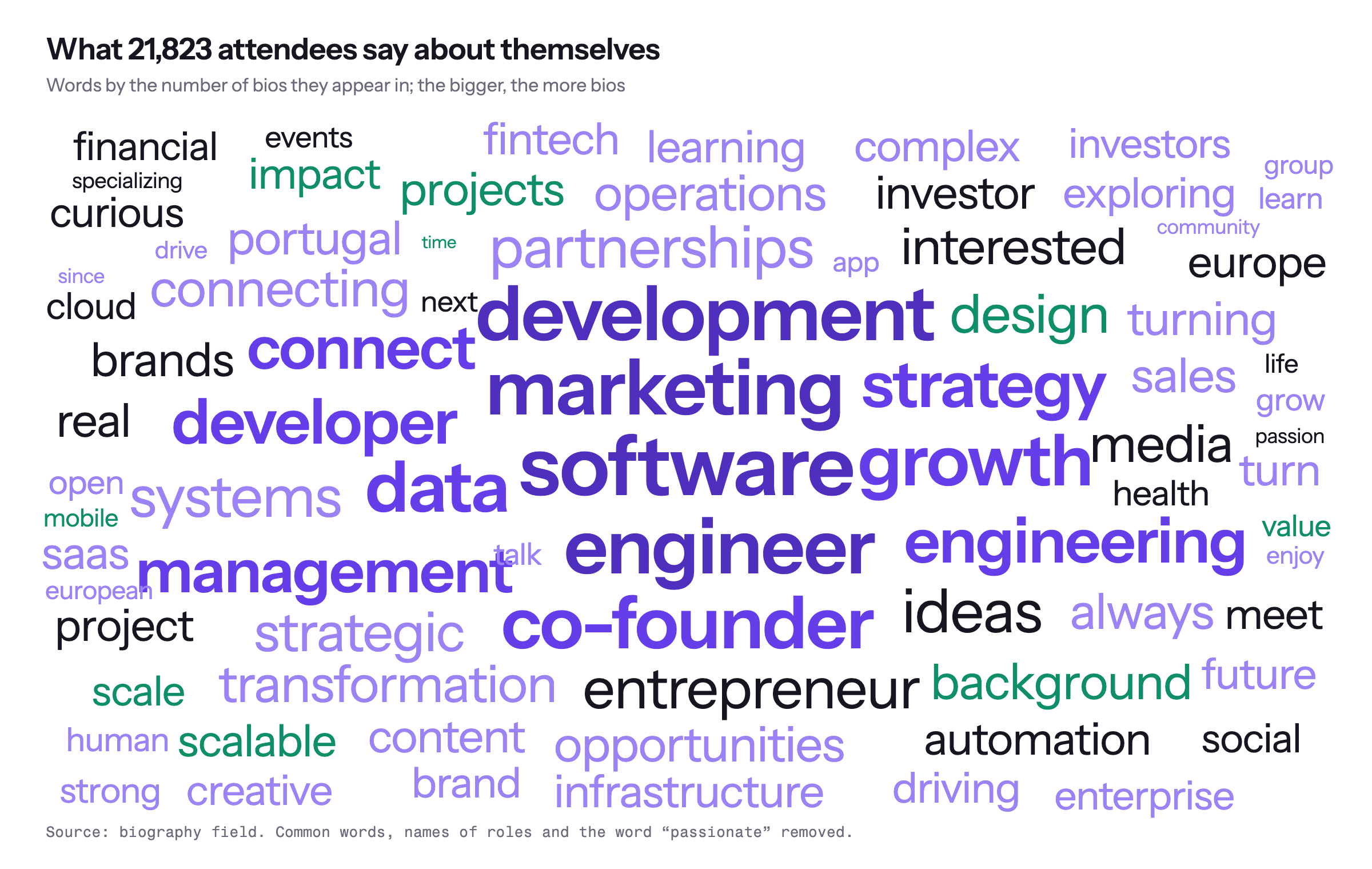
What do 21,823 people write about themselves when given a text box? Software, marketing, engineering, growth and co-founder, mostly. Strip out the job words and “ideas”, “connecting”, “curious” and “impact” are what’s left.
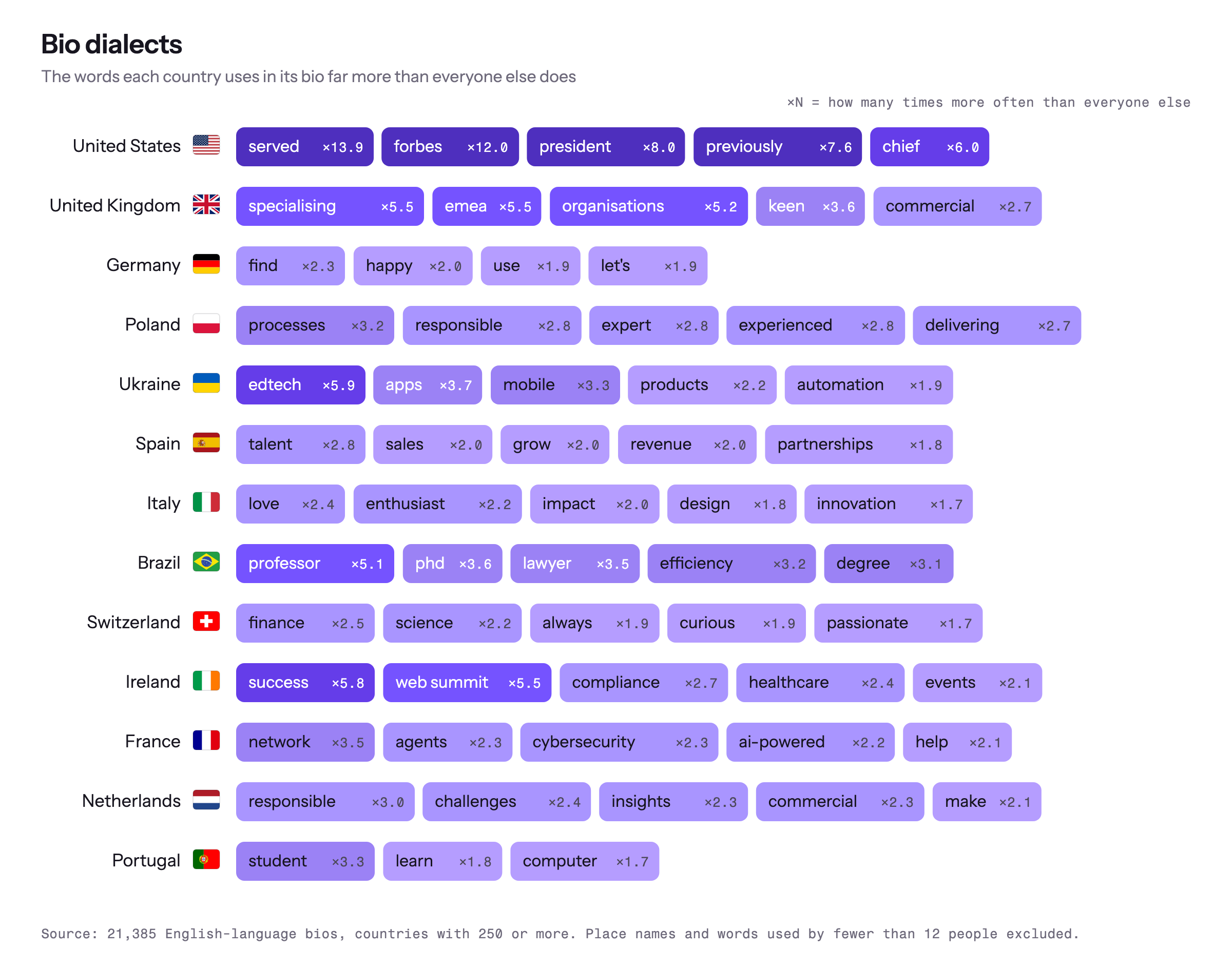
The bios also have accents. For each country we compared how often a word appears in its bios with how often it appears in everyone else’s, and kept the words with the biggest gap. Americans write résumés. “Served” is 14 times more common in an American bio than in anyone else’s, “Forbes” 12 times, “president”, “previously” and “chief” six to eight times. No other country’s bios lean on the past tense like that. The British spell it their way: “specialising”, “organisations” and “EMEA” are the top three, and “keen” is fourth. Germans write invitations, “happy”, “let’s”, “find”. Poles write competence, Ukrainians write product, Brazilians write credentials. Ireland’s two most distinctive words are “Web” and “Summit”, because Web Summit is a Dublin company and this is its staff. Portugal’s are “student” and “learn”.
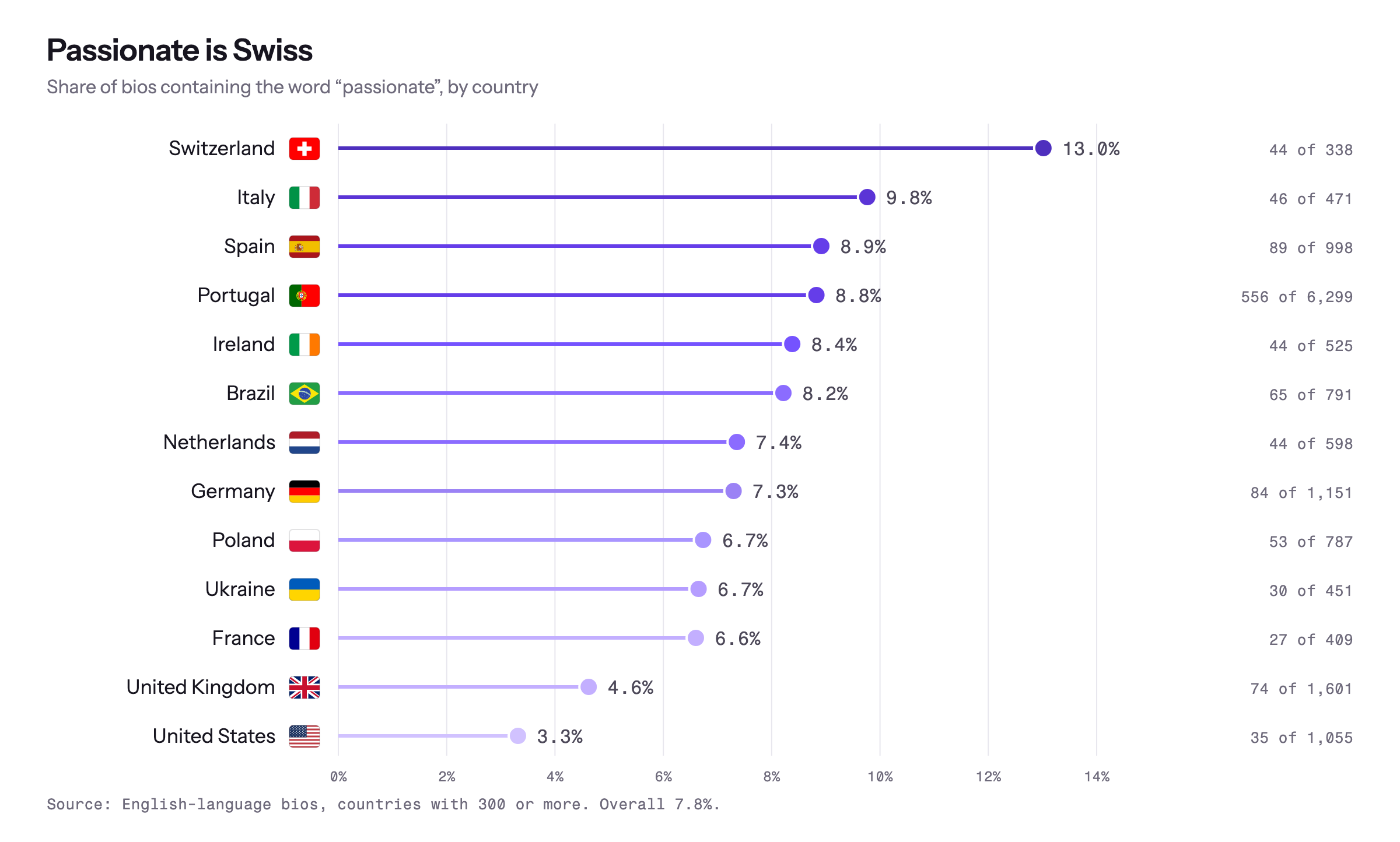
And one word on its own. “Passionate” appears in 1,703 bios, one in thirteen. Passionate is Swiss: 13% of Swiss attendees use the word, against 3% of Americans and 5% of Brits, with everyone else in a band between 7% and 10%.
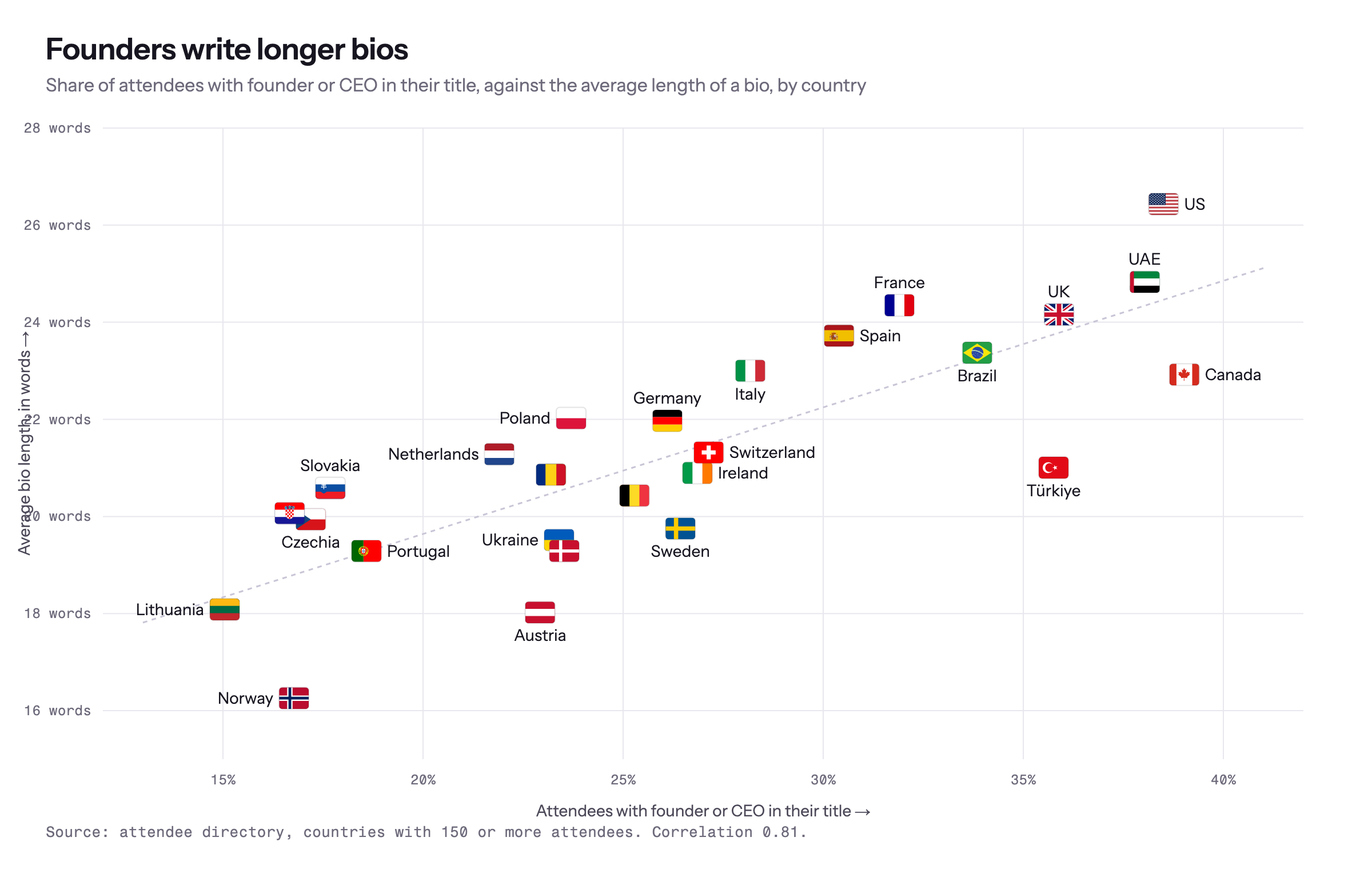
Length tells you something too. The more founders a country sends, the longer its bios run. Americans average 26 words and 39% of them are founders or CEOs. Norwegians average 16 words and 17% are. Lithuania and Portugal keep company with Norway at the short end. Canada and Türkiye are the ones who break the pattern: plenty of founders, not much to say about it.
A few more from the biographies:
- Forty-four bios contain the word visionary. Ninety-seven say serial entrepreneur.
- Only 27 people call themselves a ninja, guru, wizard or evangelist. The genre is dying out.
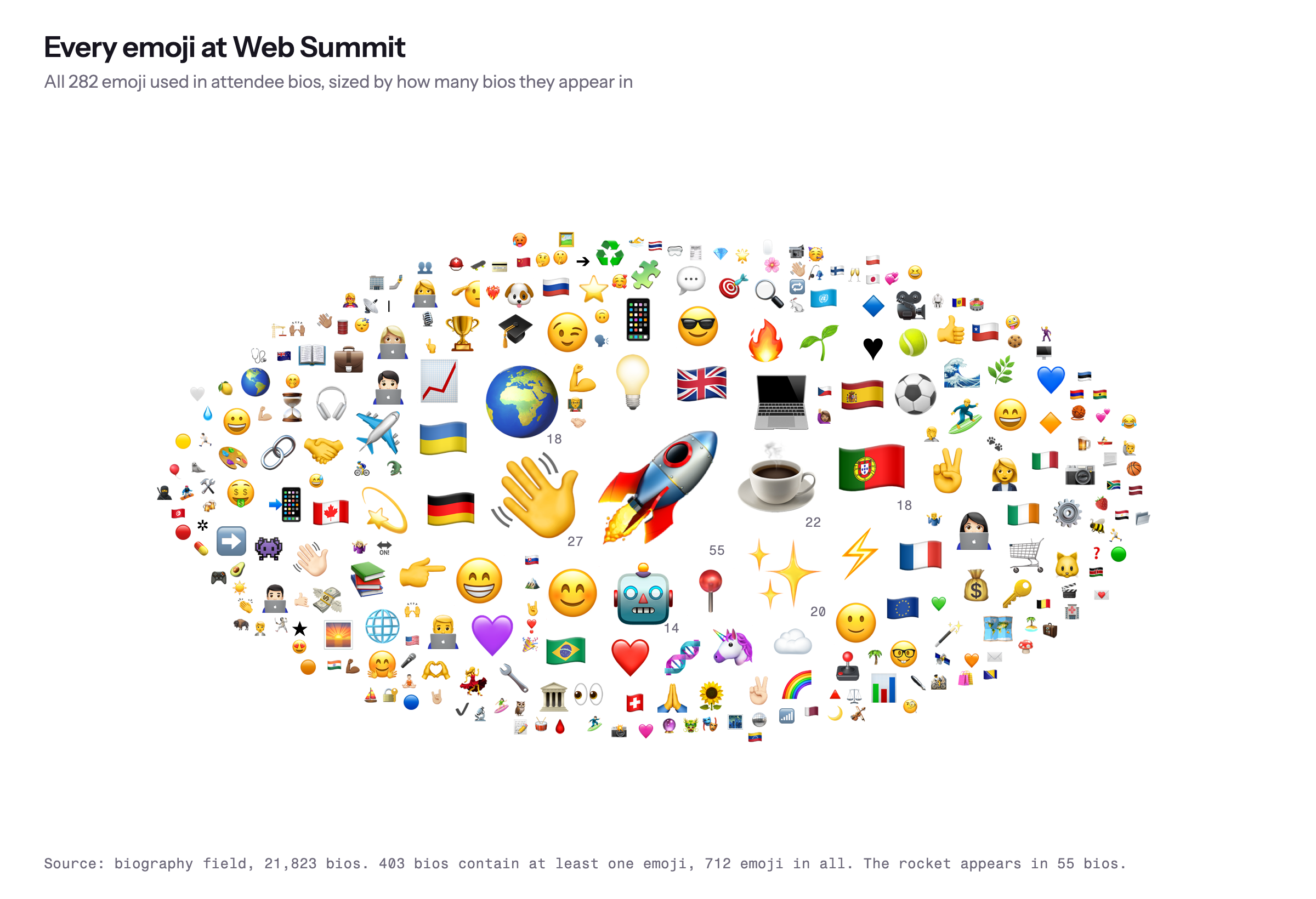
- 403 bios contain an emoji, 712 emoji in all. Fifty-five of them are rockets. Ukraine leads at 4% of bios, the US is at zero.
- 141 bios mention Google, 54 mention Forbes, 104 mention coffee and 27 mention surfing. This is Lisbon.
- The longest job title runs to 165 characters and belongs to a professor of public affairs at the University of Texas. The median is 15.
The rocket is the house emoji of the startup world and it wins here too, but the wave, the coffee cup and the Portuguese flag are close behind, which is about right for Lisbon in November. Then a long tail: 282 different emoji in all, most used by exactly one person.
The startups
2,565 startups are exhibiting, across Web Summit’s Alpha, Beta and Growth tiers, from 98 countries. The UK edges Portugal here (316 to 309), then Brazil, the US, Germany and Spain.
Most of them are early. Of the startups that stated a revenue band, 40% are pre-revenue and another 39% are under $100,000 a year. Ninety-seven say they make more than a million. 55% say they’re actively fundraising.
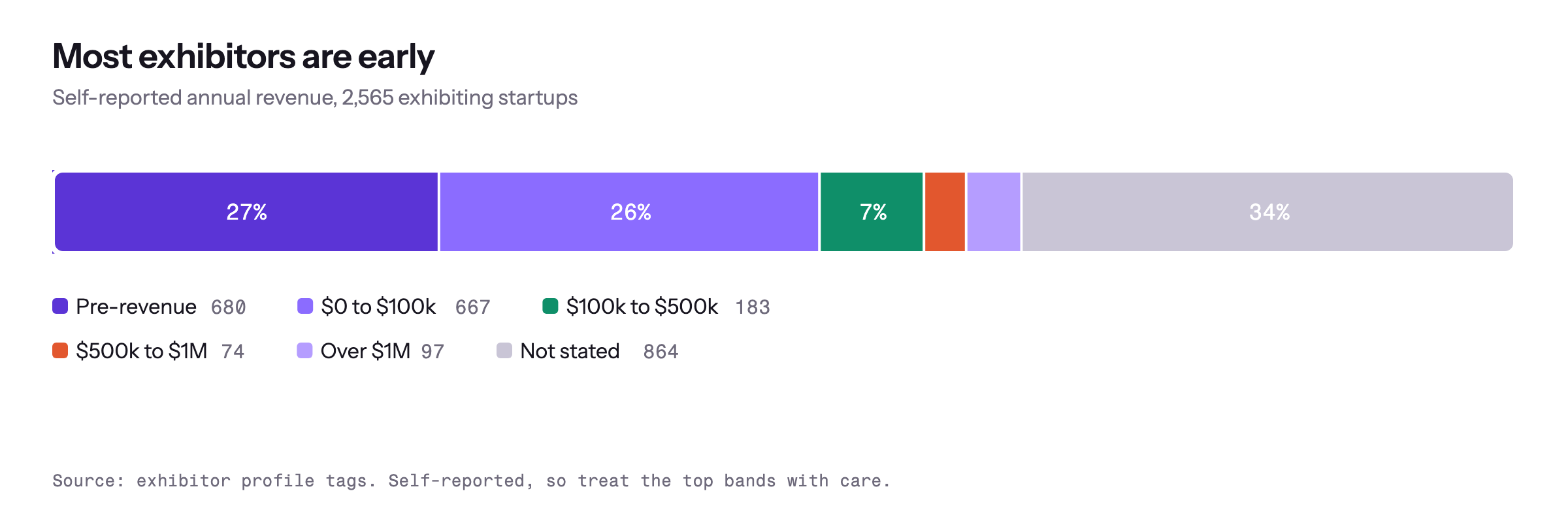
The average team listed on a stand is 1.8 people. Over a thousand startups are bringing one.
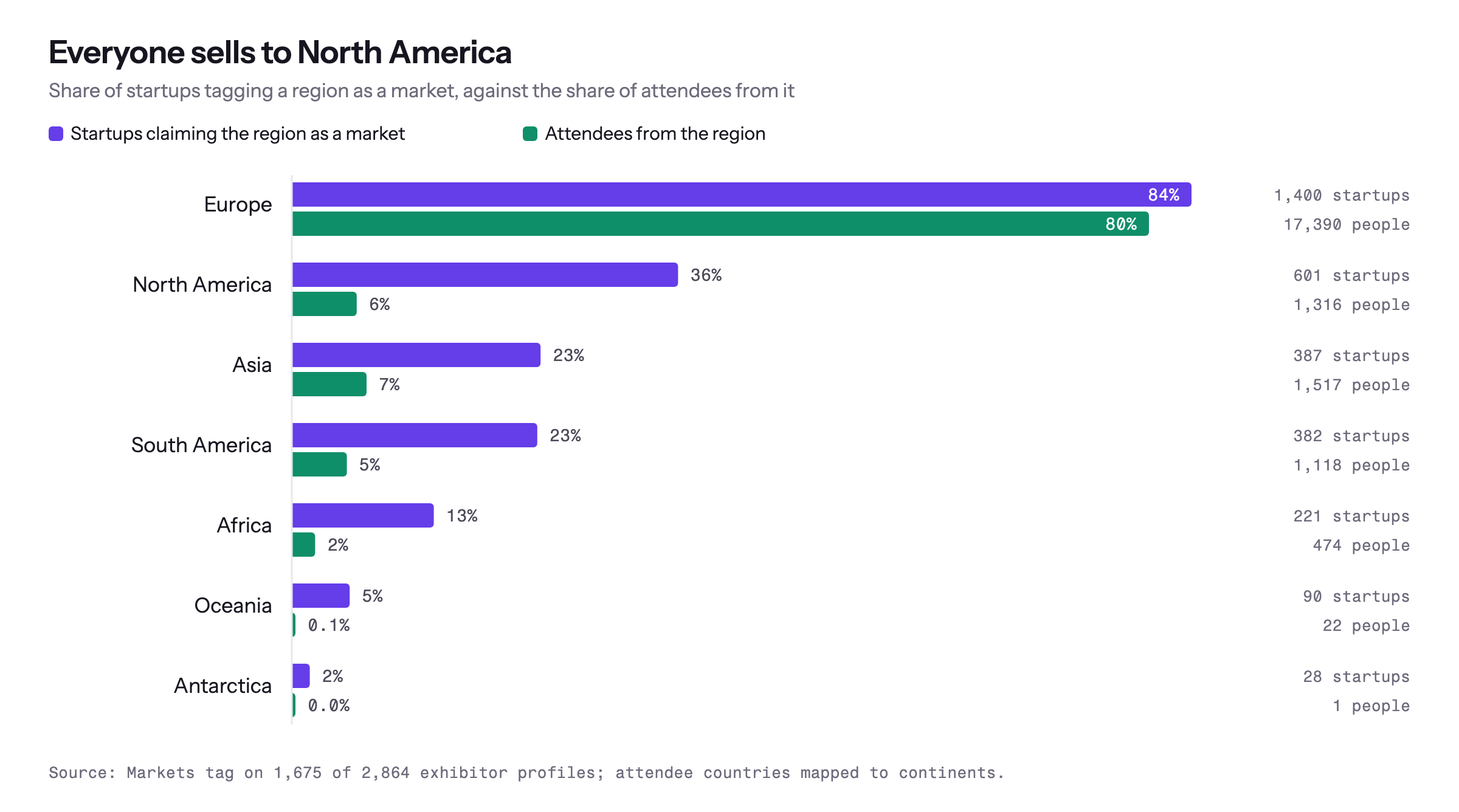
Then there’s where they say they sell. Web Summit asks each startup to tick the continents it serves, and 1,675 did. 84% ticked Europe, which is where 80% of the room is from. 36% ticked North America, which is where 6% of the room is from. Africa is claimed by 13% of startups and supplied 2% of attendees. Oceania is claimed by 90 startups and sent 22 people. Fifty-three startups ticked all six inhabited continents, and 28 ticked Antarctica. One attendee lists Antarctica as their country, so at least they have a lead.
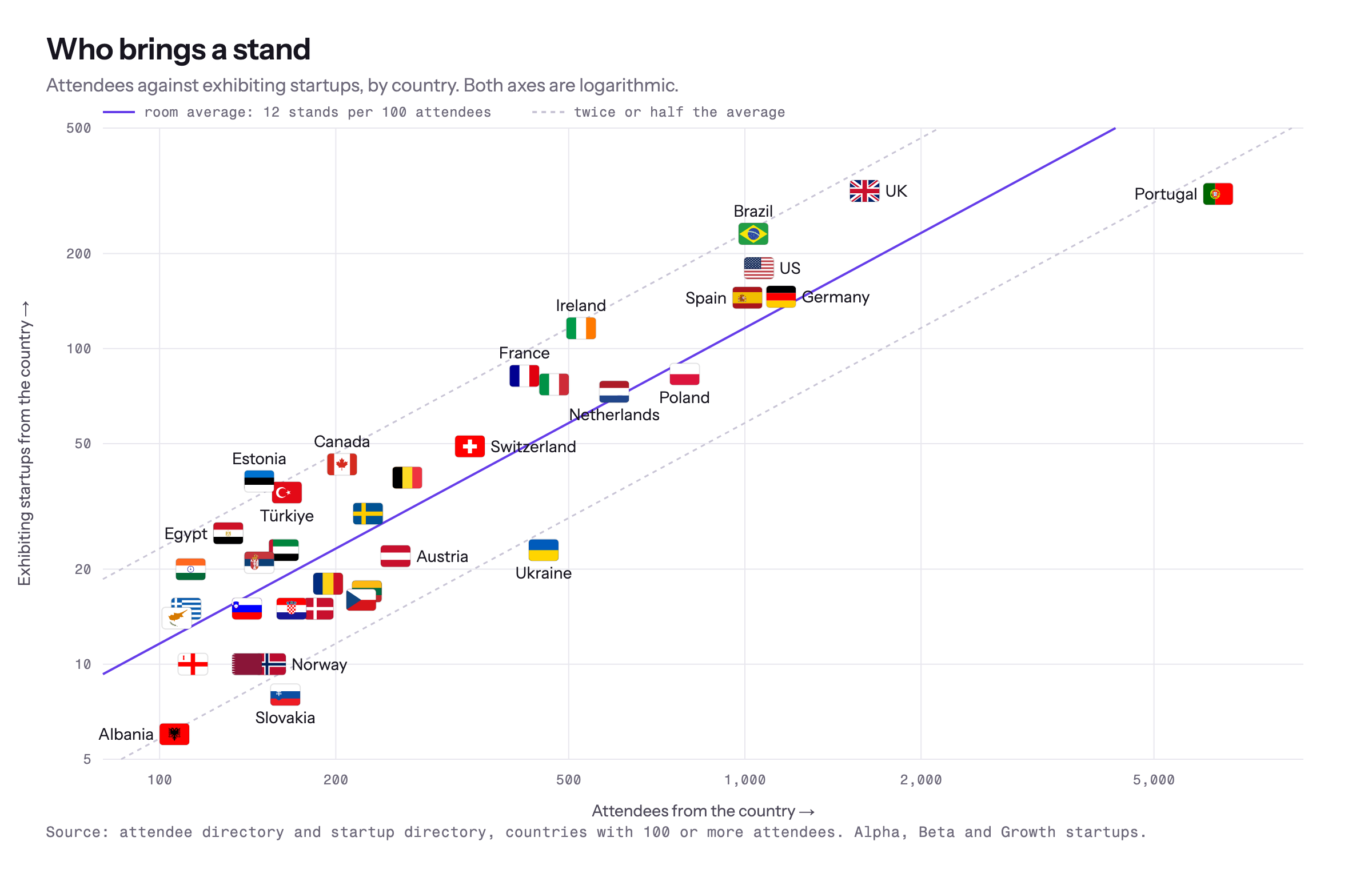
Flip it round and plot each country’s stands against its crowd. Overall there are about 12 exhibiting startups for every 100 attendees, and most countries sit close to that line. Estonia, Brazil, Ireland and the UK are at double it: they come to sell. Portugal, Slovakia, Ukraine and Norway are at half: they come to look. Brazil sent the fifth-largest delegation and the third-most startups, and we already know its startups skew towards the ones with revenue. Brazil is not here to browse.
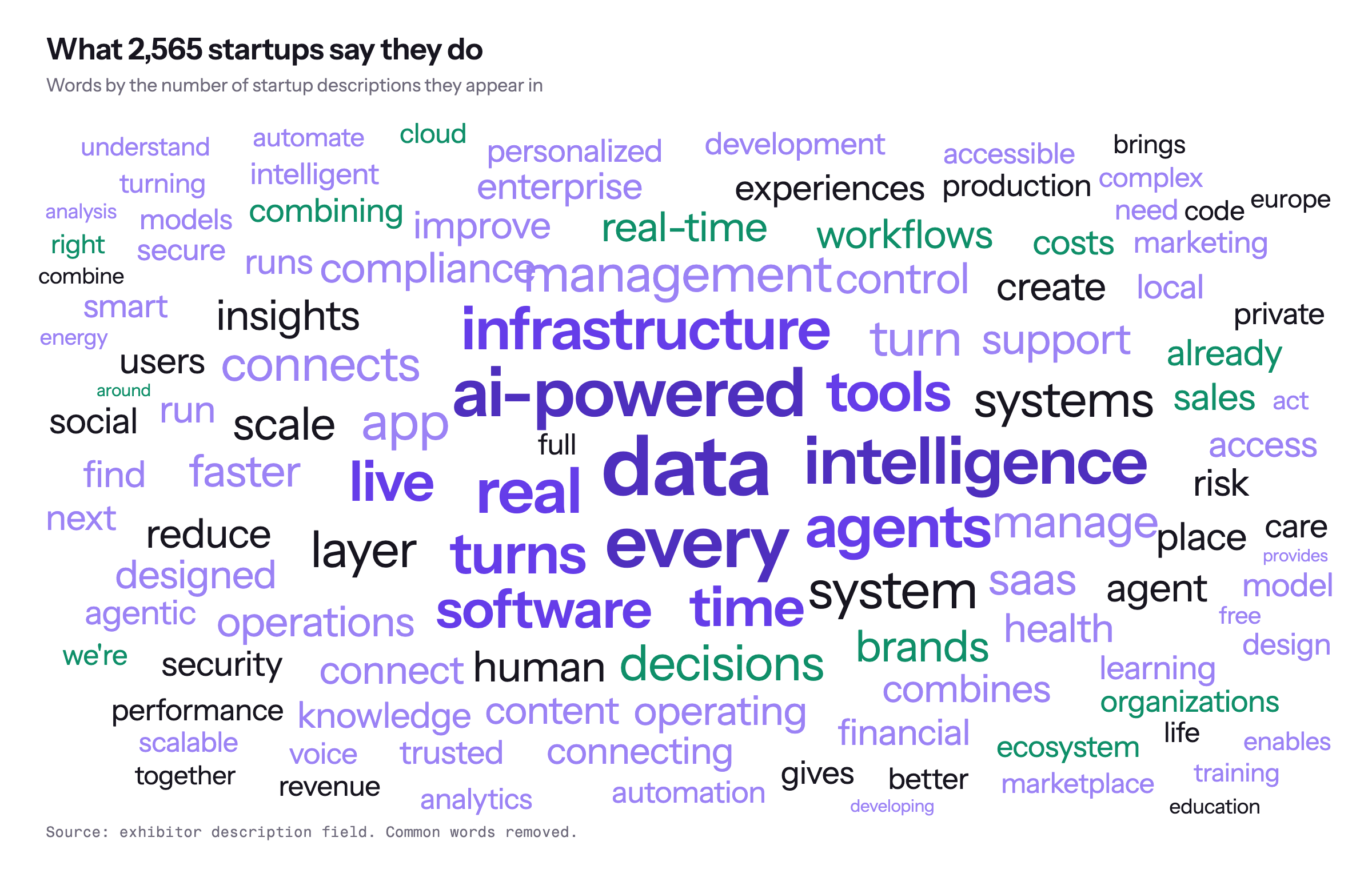
The descriptions read differently from the bios. Attendees talk about themselves; startups talk about data, intelligence, agents, infrastructure and “real time”. The word “every” is in 340 of them, usually followed by “business” or “team”.
And the number we care most about: how many of the 2,565 startups are in our business? We searched every description for scraping, crawling, web data or data extraction and got four hits. Then we read them. Arbling verifies agentic commerce, HoneyLog tells you which bots are scraping you, and San Jose Automation matched on manufacturing scrap. That leaves one startup out of 2,565, MyDatAgent, plus two companies on the partner list rather than the startup floor: Apify, the actor marketplace, and Infatica, a proxy network. The field is wide open, which is either very good news or a sign we should check our assumptions. If you want to see how we think about the market, our guide to data extraction tools covers the nine products we’re usually compared with.
The programme
671 scheduled sessions, of which 180 are meetups and 491 are on a stage: keynotes, firesides, panels and masterclasses across 28 stages over three days.
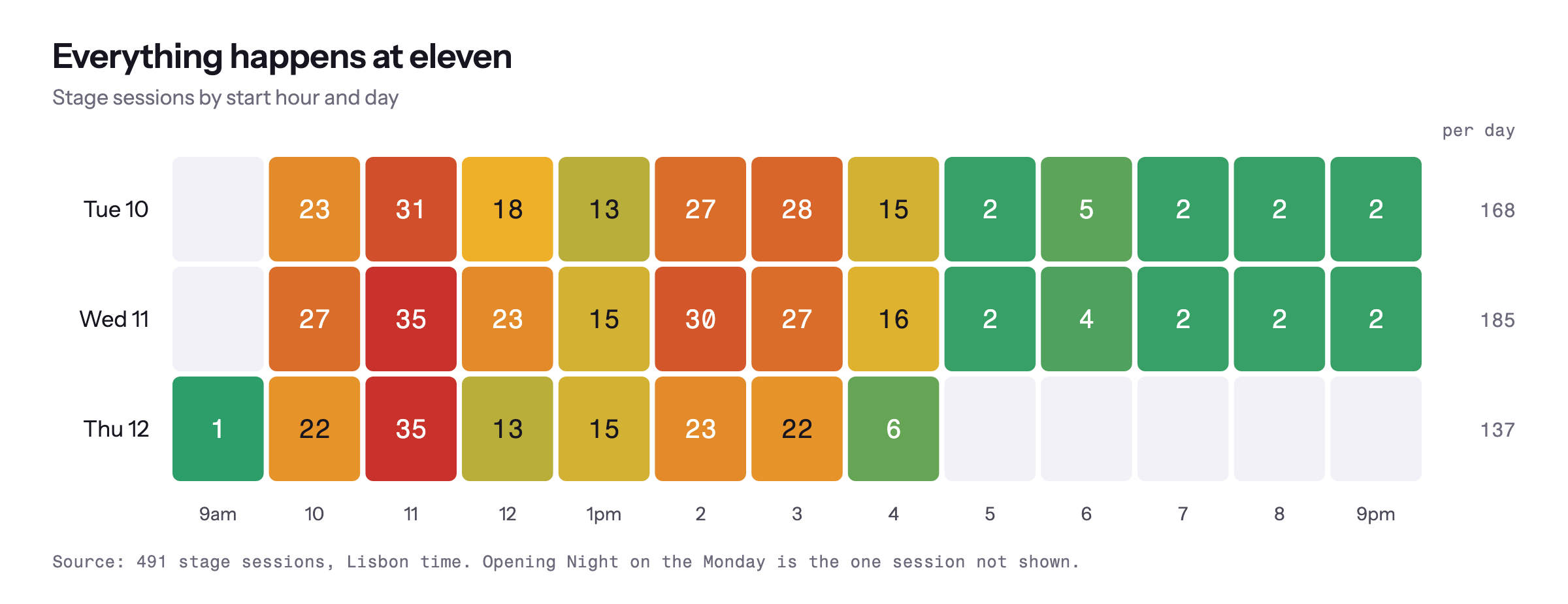
If you’re planning your days, know that everything happens at eleven. A hundred and one sessions start in the 11am hour, more than at any other time, and the afternoon peak at two and three is nearly as crowded. Wednesday is the busiest day, with 185 sessions. Thursday thins out after four. On the other two days the stages drop to a couple of sessions an hour from five, and Night Summit takes over.
- The median stage session is 20 minutes. Keynotes and firesides are 20, panels 25, masterclasses 45.
- 64 session titles are questions. “Do we need a UN AI treaty?” “Are job interviews real anymore?” “Who pays for AI and who owns it?” “What makes a startup fundable in 2026?” We’ll report back.
- 764 people are speaking. Thirteen of them speak three times, including Sarah Kunst of Cleo Capital, economist Mark Blyth, geopolitical analyst Bruno Maçães and David Brevik, who co-created Diablo.
- The moderators are journalists. The Financial Times has eight speakers on the programme, the BBC six, CNN and the Wall Street Journal five each. Qualcomm and Intel also have five.
- Richard Socher of You.com has two sessions. One is called “When AI builds itself”.
One more cross we hadn’t seen anyone run: who is on a stage, and who has a stand? We matched every programme speaker to the exhibitor list, by company name and by the people each stand lists as its team. Of 2,565 exhibiting startups, 22 have anyone on the programme. Six of the 2,007 Alpha-tier startups do. Partners, the sponsors, are at one in four.
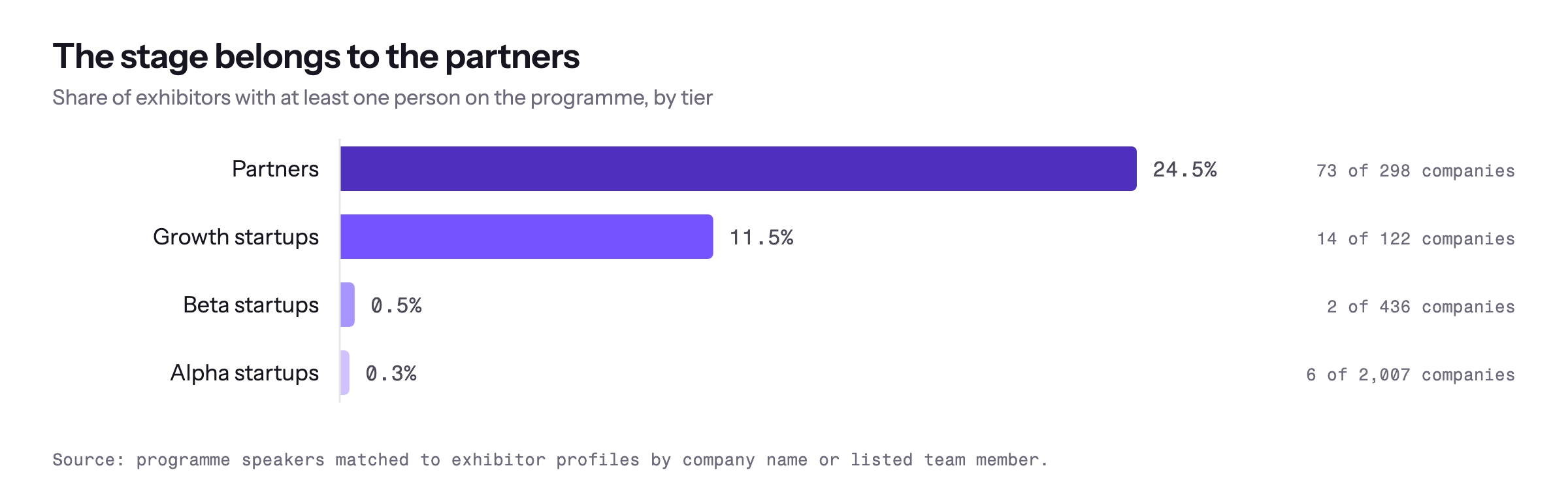
The stage and the floor are two different conferences that share a venue. The speakers who aren’t partners are journalists, investors, academics and politicians, not founders. We expected startups that are raising to over-index on speaking slots, since a stage is free reach. It’s the other way round: 32% of the startups with a speaker say they’re fundraising, against 55% of those without. If you’re a founder hoping to be discovered from the audience, the numbers say the stand is the better bet.
The AI question
Which isn’t a question any more. We counted mentions of AI, machine learning and LLMs in all three tables, and crypto, web3 and blockchain alongside for comparison.
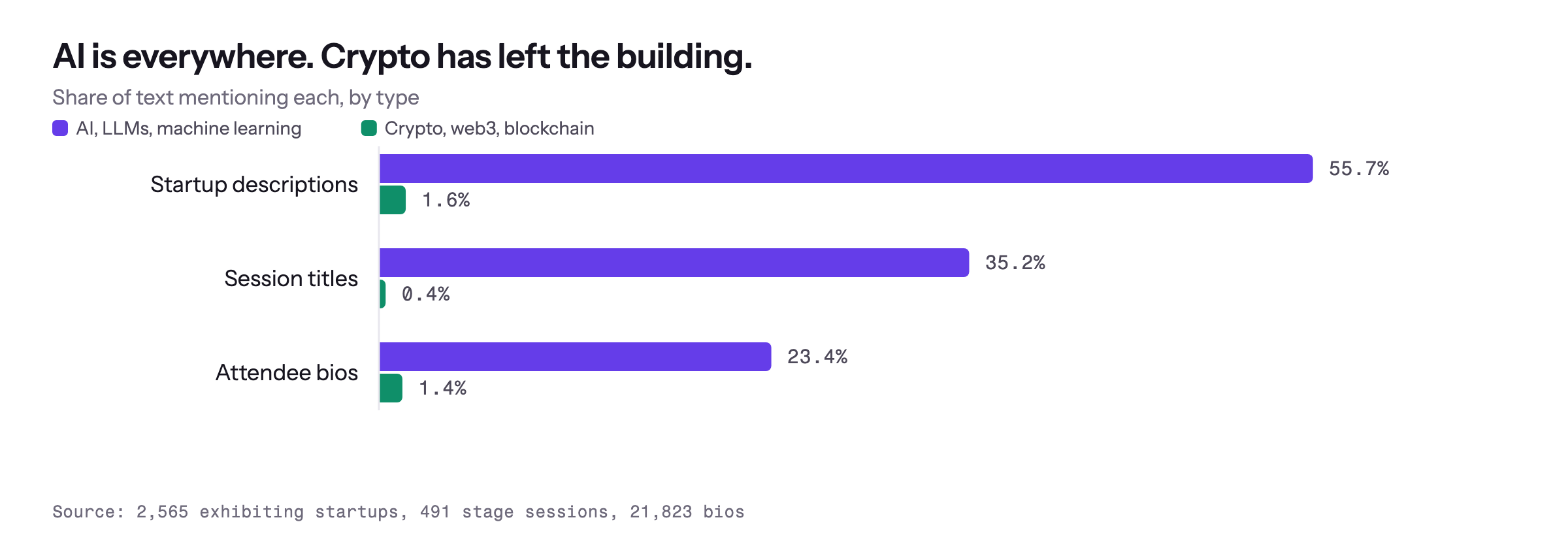
56% of startup descriptions mention AI. In the “AI & machine learning” category it’s 85%, but even in healthtech it’s half. Crypto, web3 or blockchain: 41 startups, 1.6%, once we had read the matches and removed the ones talking about LLM tokens or cryptography. We’d bet that at the 2022 edition those two numbers were the other way round.
35% of stage sessions have AI or agents in the title, 173 of 491. Crypto gets two. Even so, the AI Summit is only half AI: 51% of its session titles mention it, behind the Corporate Innovation Summit at 57% and the masterclasses at 55%. MoneyConf is at 16% and Night Summit at zero, which seems healthy.
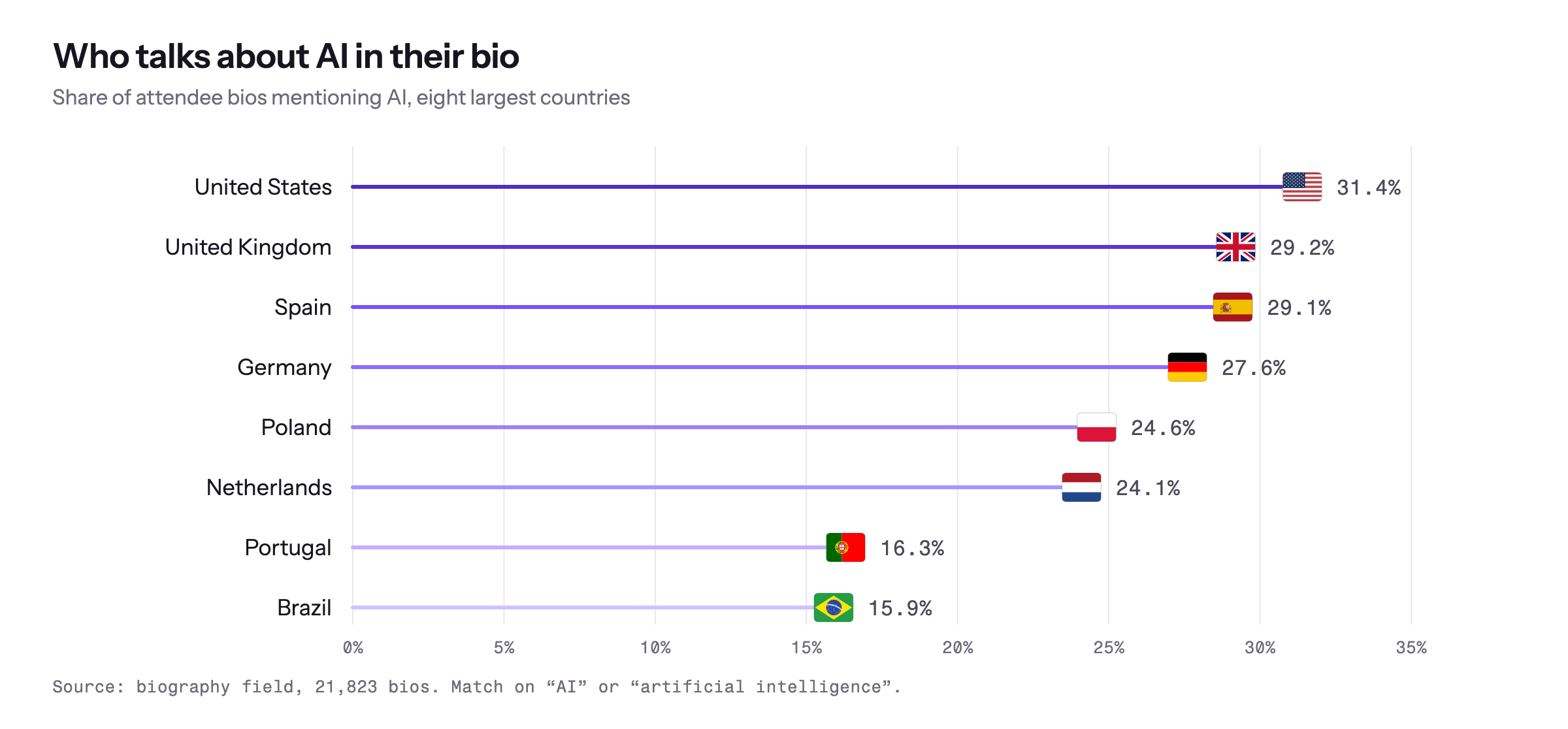
23% of attendee bios mention AI, and 193 people describe themselves or their work as “agentic”. That number hides a split by country. Attendees from the US, UK and Spain mention AI in about 30% of bios. Attendees from Portugal and Brazil mention it in about 16%. The hosts are more relaxed about it than the visitors.
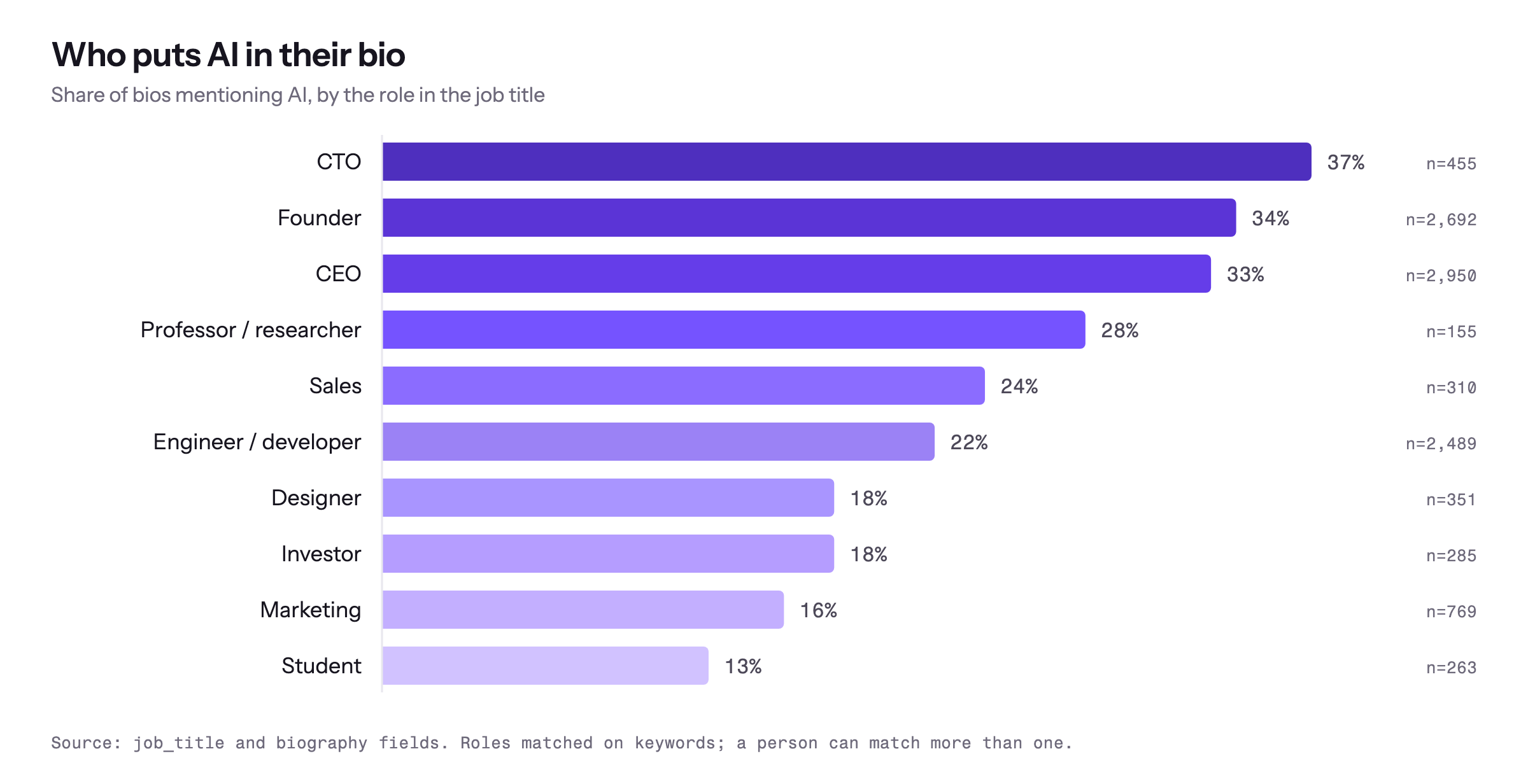
It splits by job too. CTOs mention AI in 37% of their bios, founders and CEOs in a third. Engineers, the people who build it, are at 22%. Investors are at 18%, marketing at 16% and students at 13%. The closer you are to the money or the code, the less you say about it.
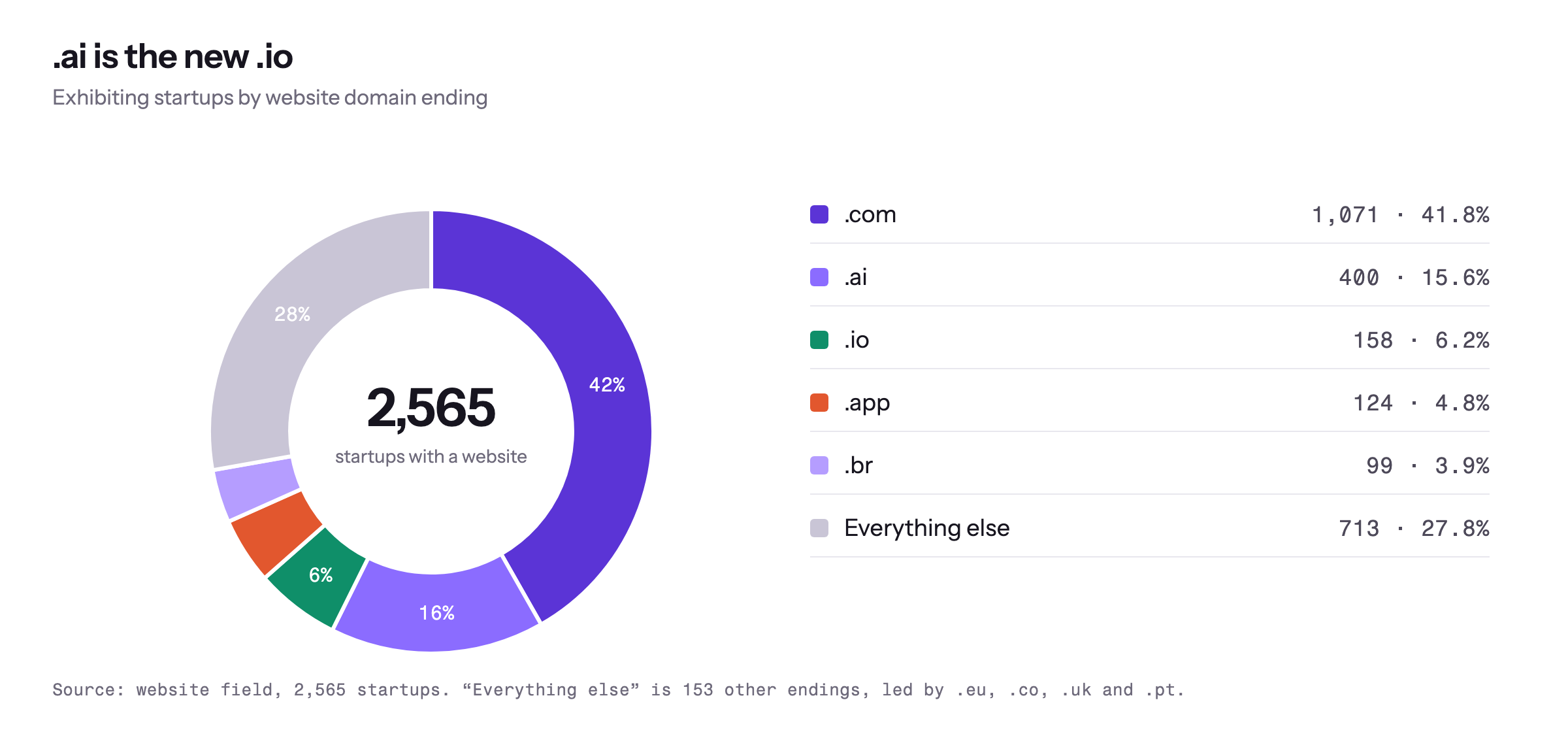
Back to the startups, who wear the label three ways. .ai is the second most popular domain ending, with 400 startups, ahead of .io (158) and .app (124). Only .com beats it. 171 startup names end in “AI”, from Rapid Deploy AI to SleekSite.AI.
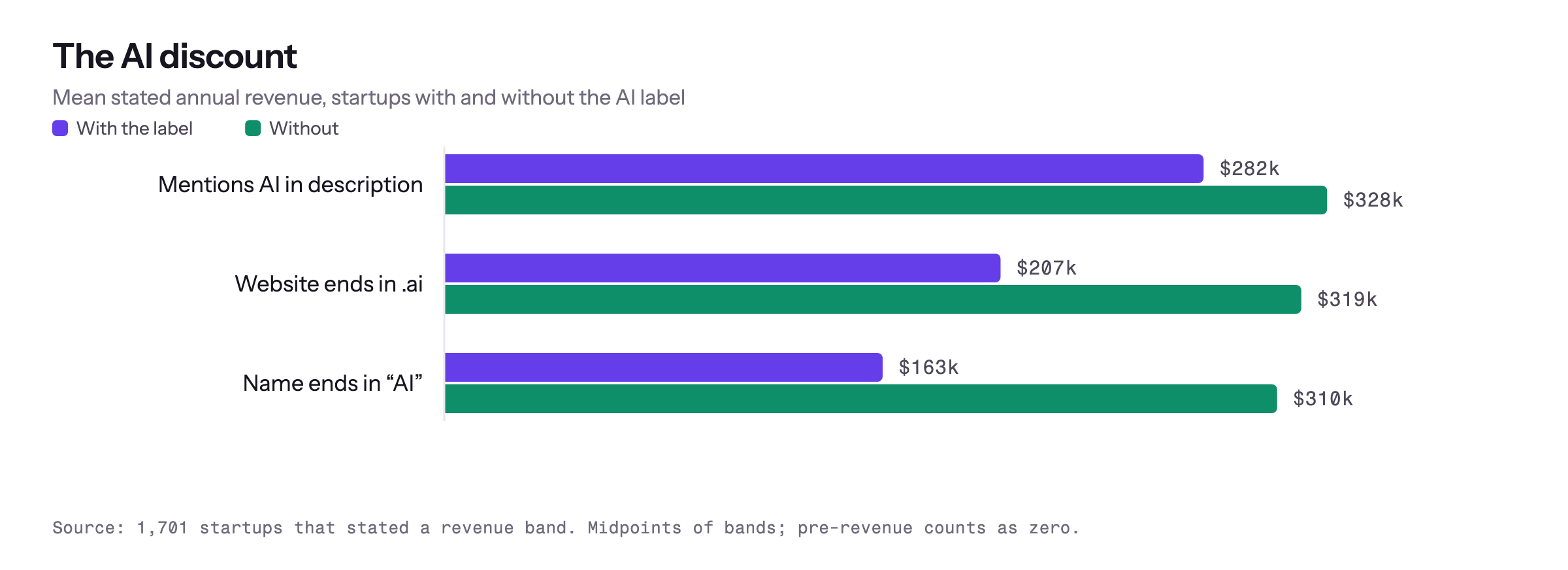
The AI discount. Startups that mention AI in their description report lower average revenue than those that don’t. Startups with a .ai domain report lower still, and startups whose name ends in “AI” report about half. The label correlates with being early, not with being rich. The same startups are a little more likely to be fundraising (57% against 51%), which is the same fact from the other side.
Follow the money
We’ve already joined the tables on country a few times. Here is the rest of what moves together, mostly with the self-reported tags, with the usual warning that these are correlations in a conference directory, not causes. Revenue is each startup’s stated band scored at its midpoint, with pre-revenue counted as zero.
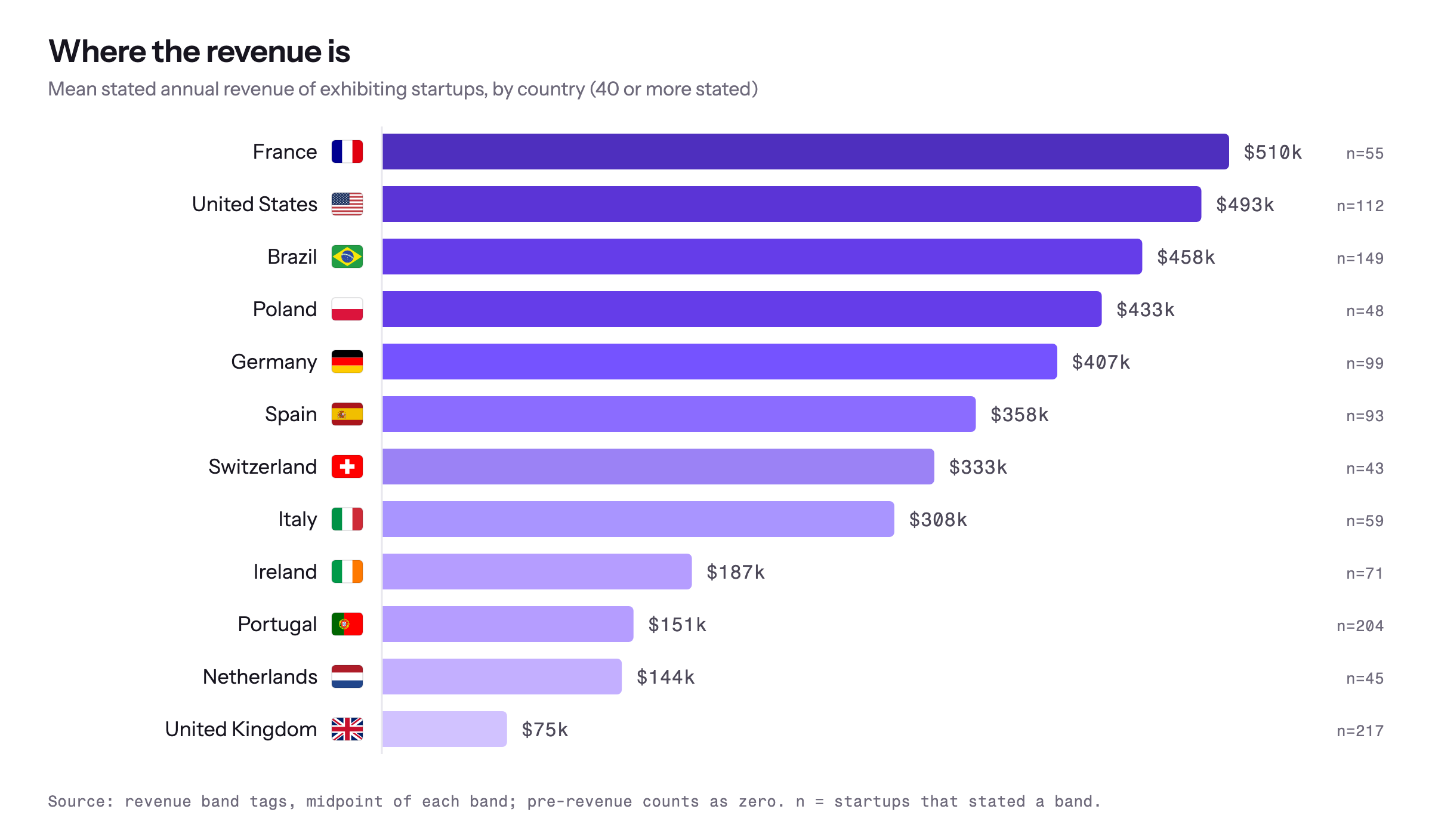
Revenue follows the passport. French, American and Brazilian exhibitors report the most; British exhibitors report the least, by a distance. Partly that’s stage: 58% of UK startups here are pre-revenue, against 18% of Brazilian ones. Brazil doesn’t send its pre-revenue startups to Lisbon, and the UK sends mostly those.
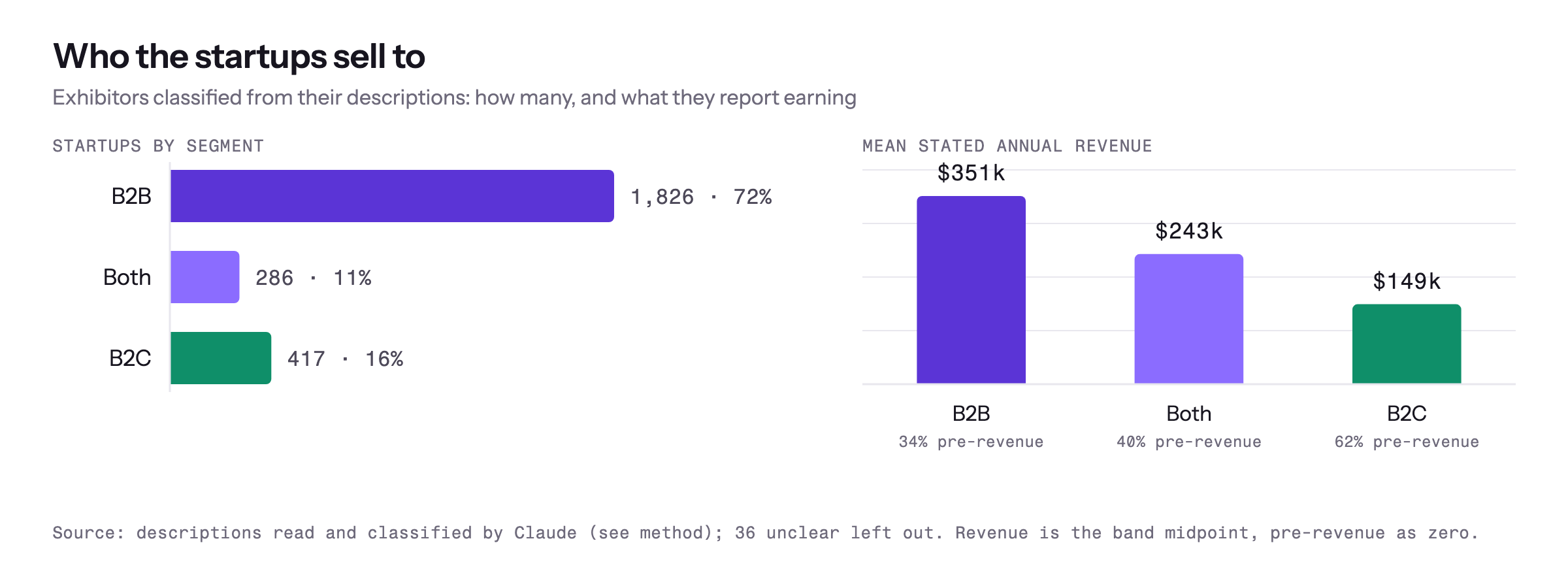
B2B is the room. Web Summit doesn’t ask startups who they sell to, so we read every description and classified it (method below). Seven in ten exhibitors sell to businesses, one in six to consumers, and one in nine to both. B2B startups report more than twice the revenue of consumer startups, and consumer startups are far more likely to be pre-revenue (62% against 34%) and a little more likely to be raising (63% against 51%). B2B is also where the AI label lives: 60% of B2B descriptions mention it, against 43% of consumer ones. By industry, B2B is AI, SaaS and fintech; B2C is healthtech, fintech, social and sports.
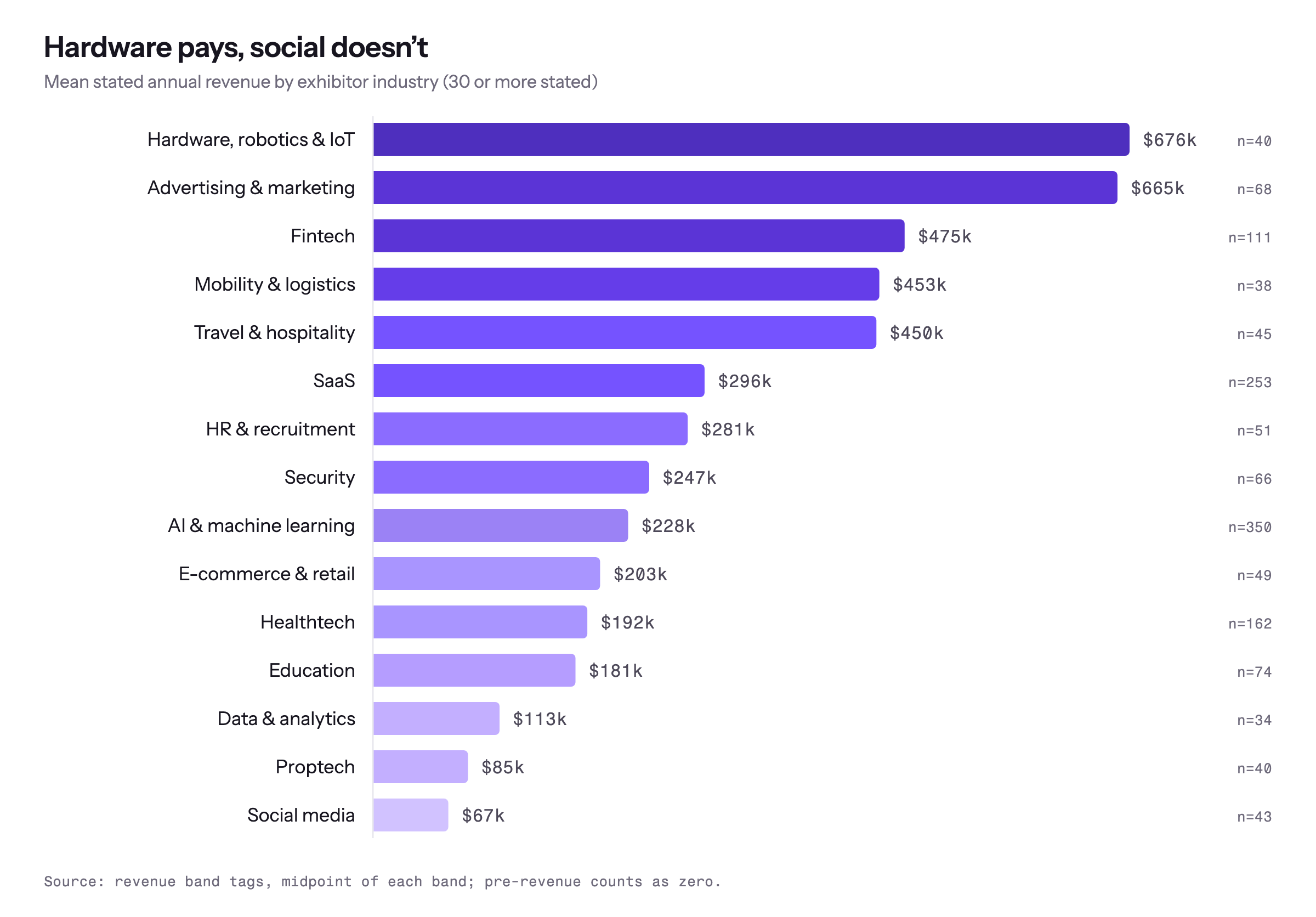
Hardware pays. Social doesn’t. By industry, robotics and hardware exhibitors report the highest average revenue, with advertising and fintech behind them. The two categories everyone is talking about, “AI & machine learning” and “Data & analytics”, sit in the bottom half, and social media is last.
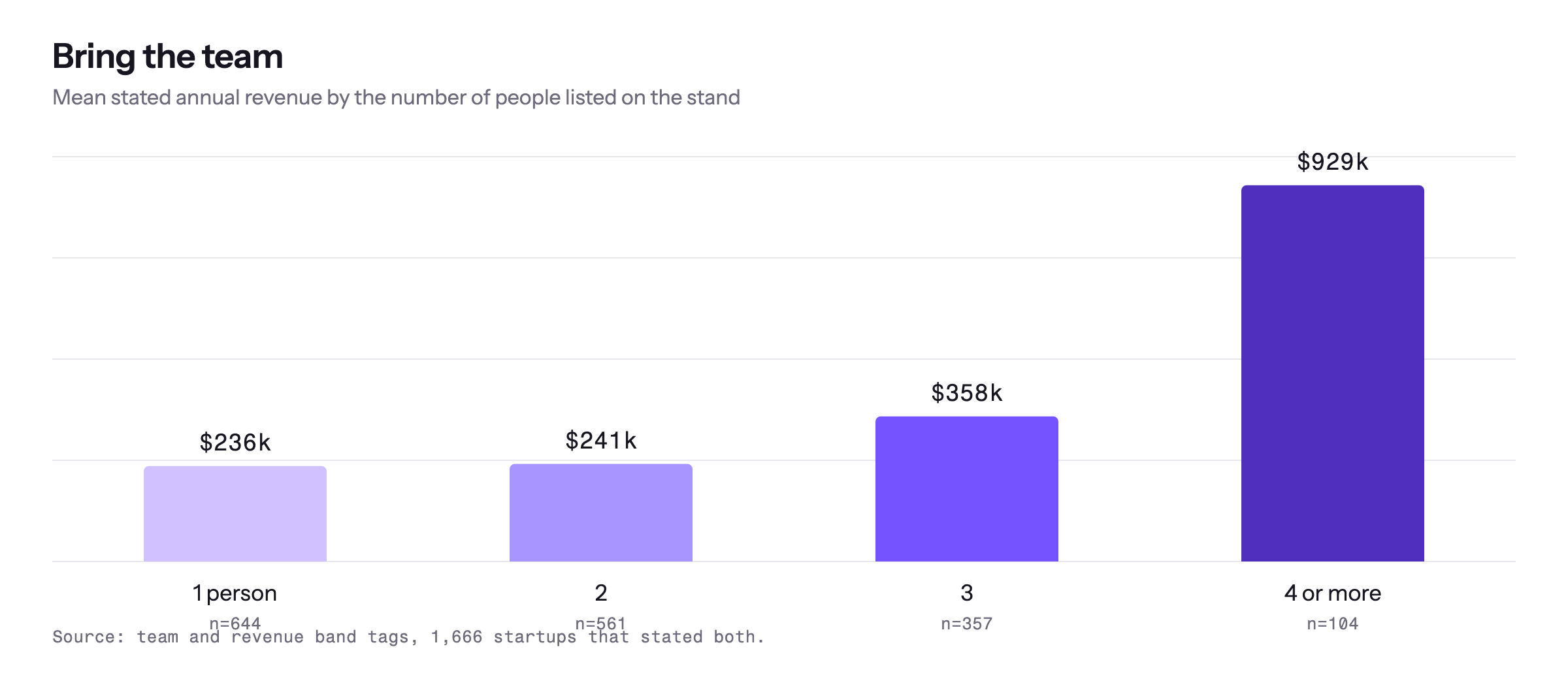
Bring the team. Startups listing one or two people on the stand report about the same revenue. Three is noticeably more, and four or more is almost four times a solo stand. Headcount at the booth is a decent proxy for headcount at home.
Fundraising doesn’t depend on revenue. 75% of pre-revenue startups say they’re actively raising. So do 76% of the ones with revenue. The only group that isn’t raising is the group that didn’t fill in the form: 12% of startups with no stated revenue say they’re fundraising, which mostly means they skipped the whole section. Fundraisers are also far more likely to have uploaded a pitch deck (63% against 40%), which is the least surprising number in this post.
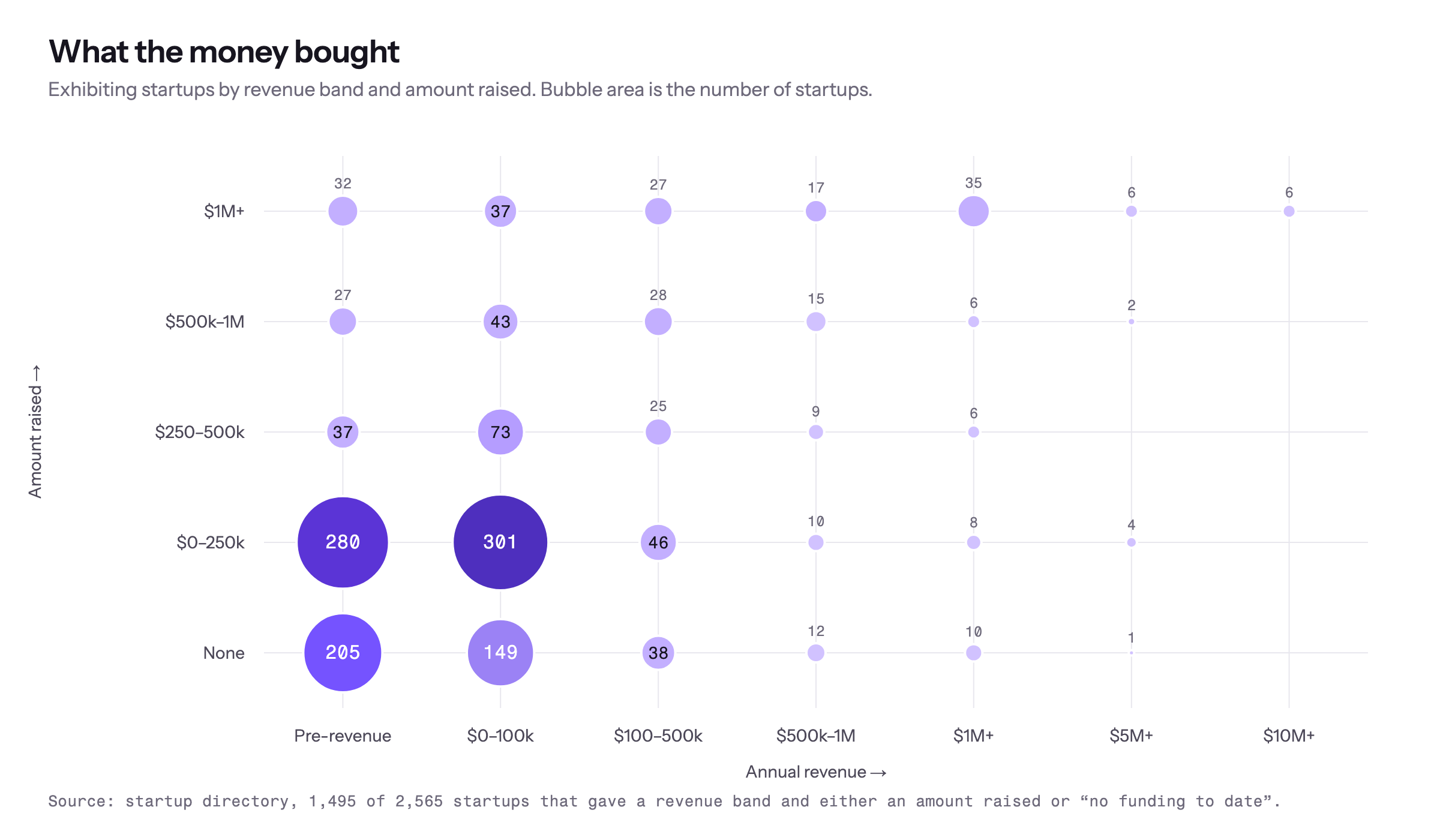
Raised money doesn’t buy revenue either. Put the two tags side by side and the room is in one corner: 935 of the 1,495 startups that answered both are pre-revenue or under $100,000, and have raised under $250,000 or nothing at all. 160 startups say they’ve raised a million or more. 69 of them are pre-revenue or under $100,000 in revenue, and 47 are over a million. It cuts the other way too: of the 84 startups making over a million a year, 23 have raised less than $250,000, or nothing.
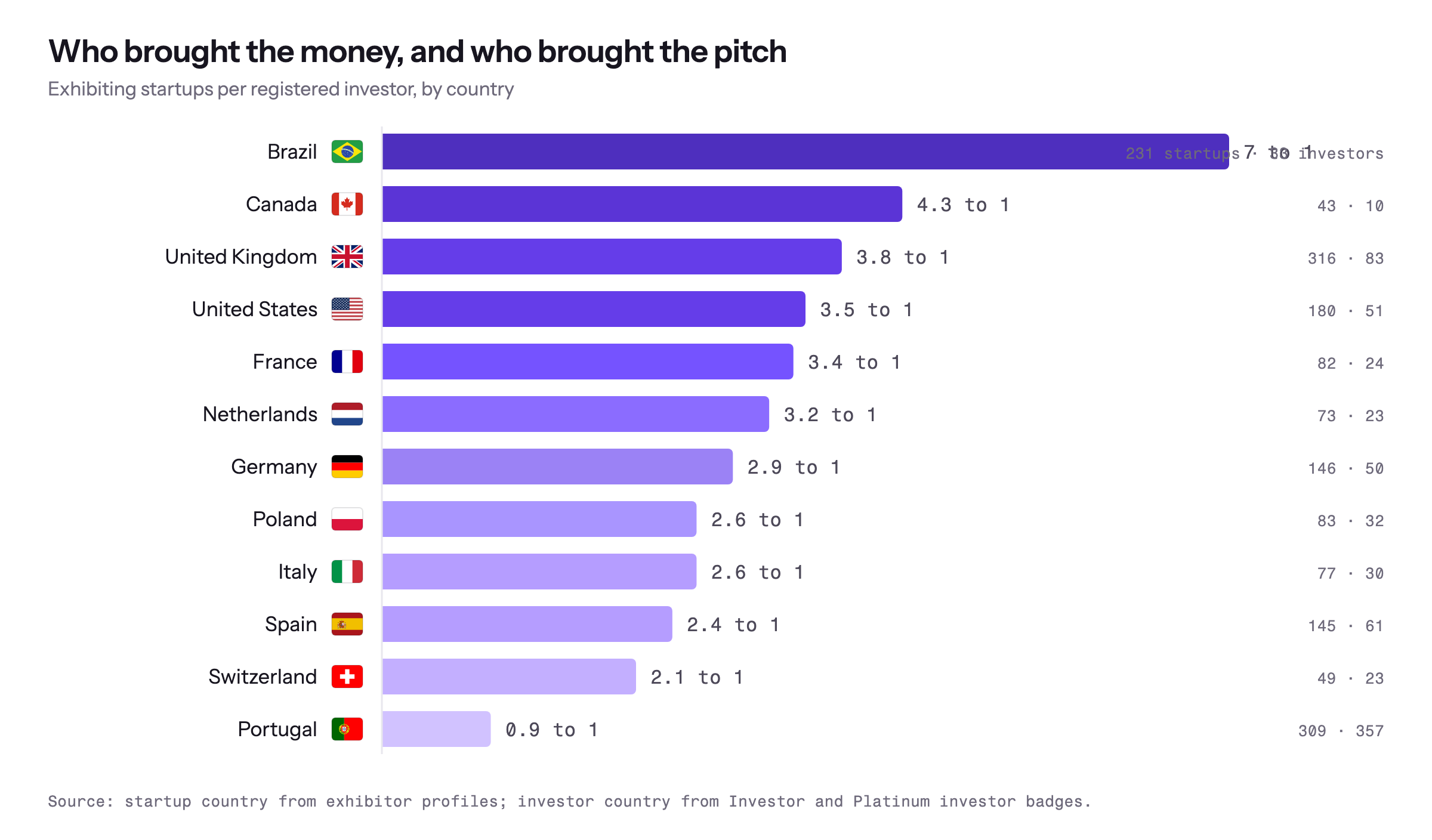
Portugal brought the investors. The directory shows 991 investors, including 314 with a platinum badge: 2.6 exhibiting startups for every investor, and 3.8 self-described founders for every investor. But 357 of those investors are Portuguese, against 309 Portuguese startups, so the hosts have more investors than startups. Every other country is the other way round. Brazil has seven exhibiting startups for every Brazilian investor; the UK and US have about three and a half.
What we did with it
This wasn’t an exercise. We built the dataset to decide who to meet.
Coming soon
An updated post after the conference
Who we met, how the dataset picked them, and what we built for each of them before we sat down. Back here the week after Web Summit.
How we collected it
Some notes on method, because we’d want them from anyone else.
The source. The Web Summit attendee directory at attend.websummit.com: the attendees who have chosen to make their profile visible, the exhibiting companies, and the programme. Jason read the directory pages and wrote the results into three tables: participants, companies and events. There is no API; this is the web interface, read carefully and politely.
The pipelines. Jason built one pipeline per table. Each one reads the directory listing until it runs out, fans out to read each profile’s visible details, then merges the result with whatever was already saved, deduplicated on Web Summit’s own IDs. That last step is why a refresh adds new registrations without touching rows we already have.
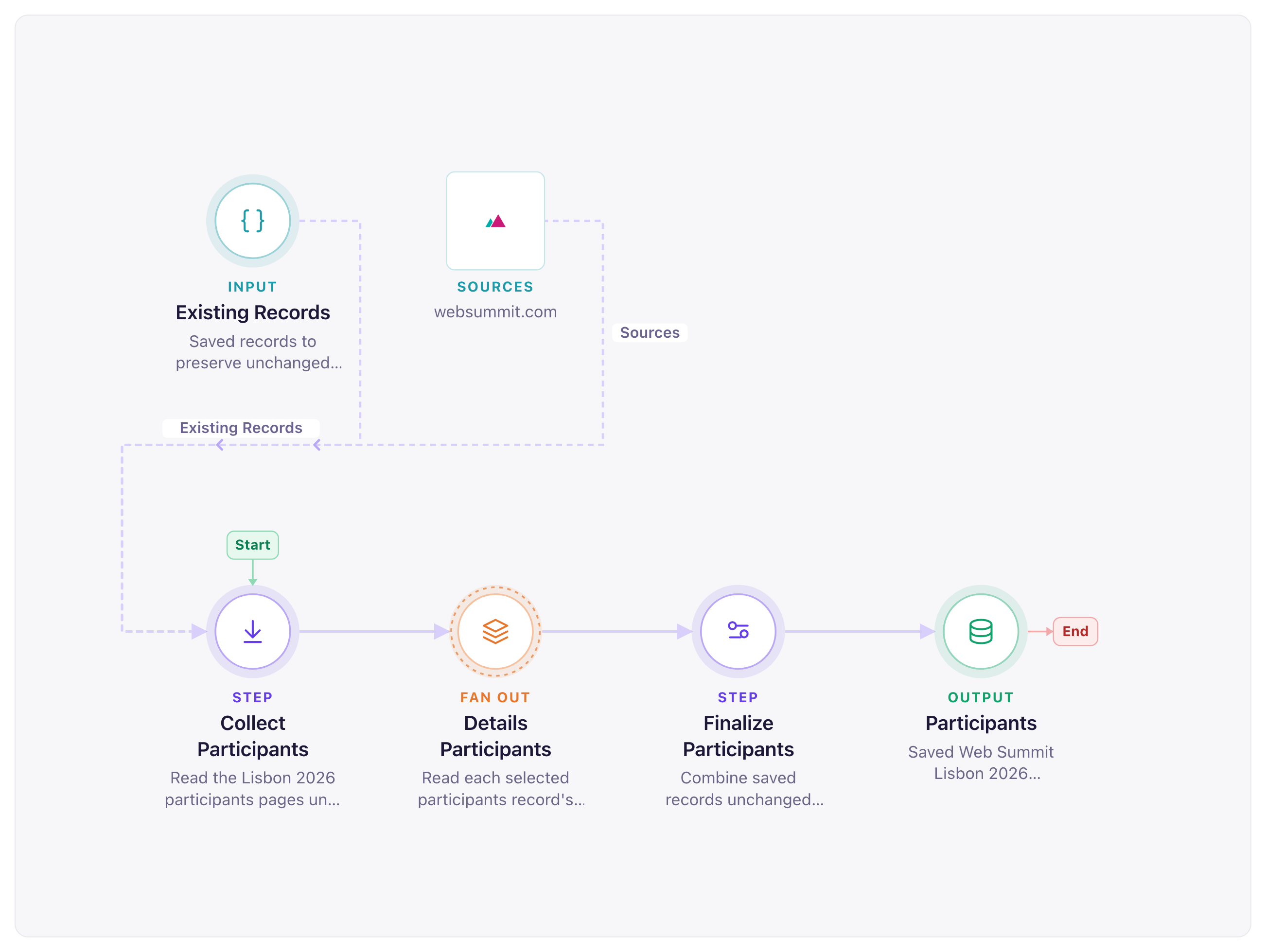
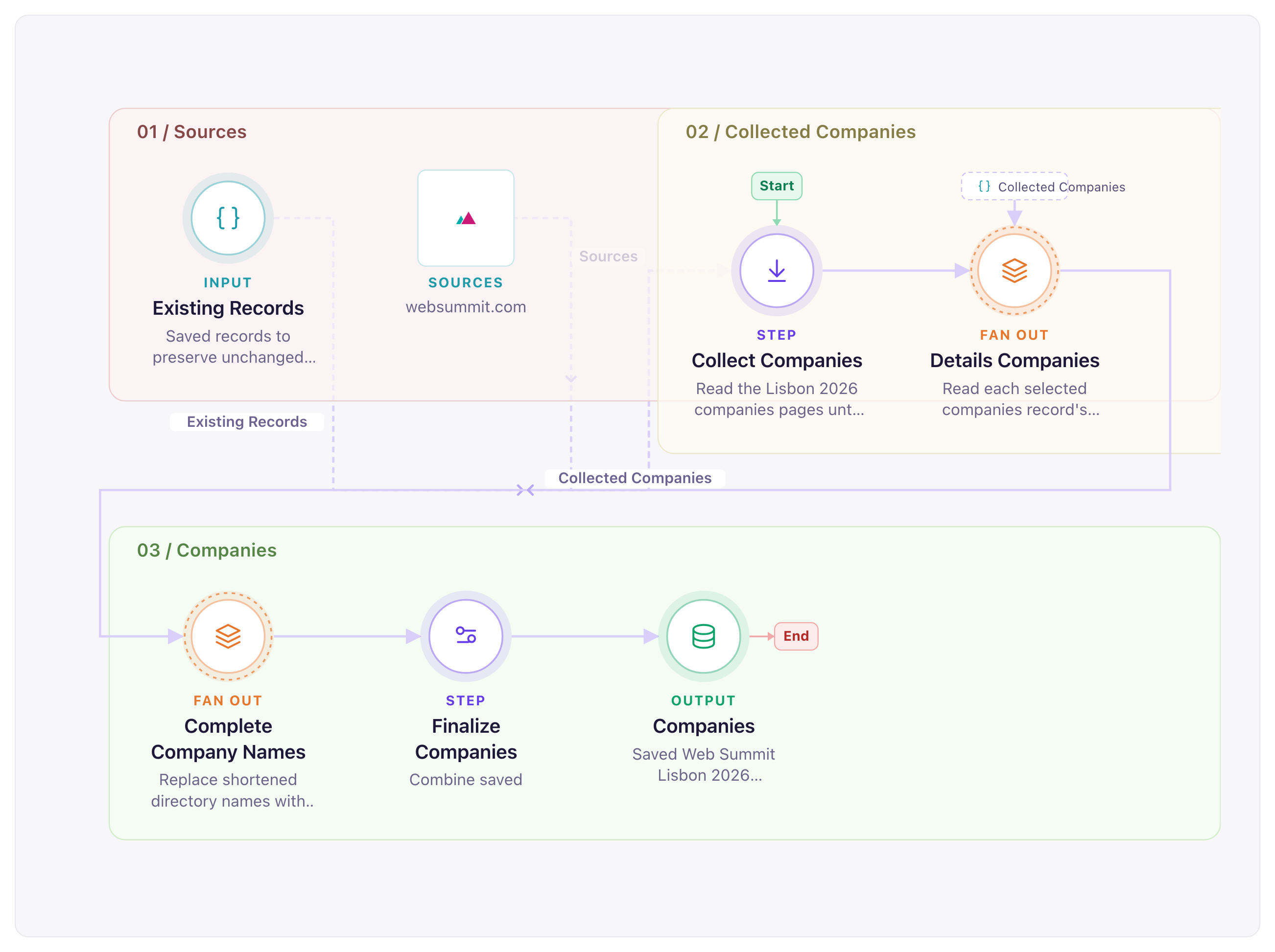
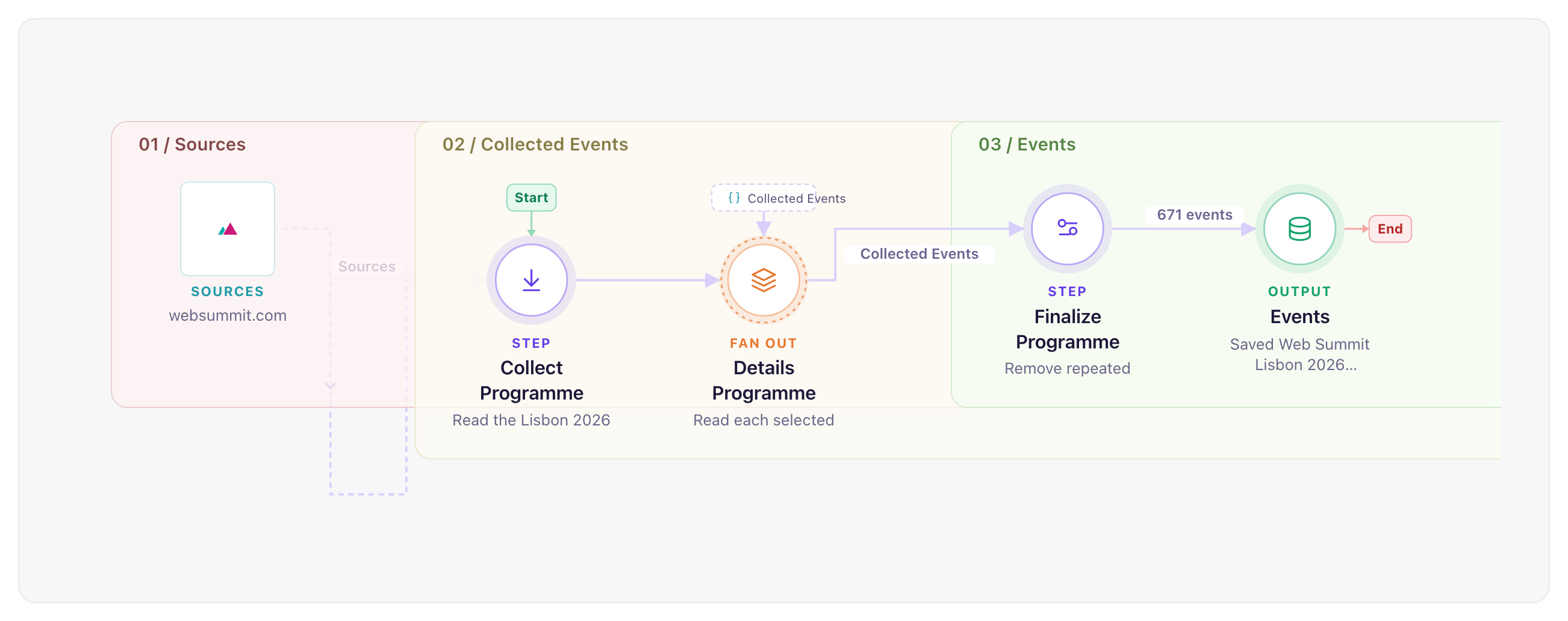
The snapshot. Participants were collected on 23 October and refreshed on 3 and 4 November. Companies were collected on 23 October with 216 added on 3 November. The programme is from 23 October. Everything here describes the directory on those dates, not the final event.
What a row is. A participant is one profile, keyed on Web Summit’s own ID, with name, job title, company, country, industry, participant type and biography. A company is one exhibitor profile with its tier, country, industry, description, website, team and the self-selected tags Web Summit asks for: revenue band, amount raised, markets, whether they’re fundraising. An event is one programme slot with its format, track, venue, start time, duration and speakers.
B2B or B2C. Web Summit has no field for it, so Claude read each of the 2,565 startup descriptions once, with one rule: B2B if the customer is a business, organisation, government or professional at work; B2C if it is an individual, patient, parent, player or household; both if it clearly serves both sides; unclear if no customer is implied. 36 came out unclear. A keyword pass over the same text agreed with the reading 70% of the time; the disagreements were mostly descriptions that mention “people” in passing while selling to companies.
Counting words. “Mentions AI” means the text matches the whole word AI, “artificial intelligence”, “machine learning” or “LLM”. “Crypto” means crypto, web3, blockchain, NFT, stablecoin, on-chain or tokenised assets; we read every match and dropped the ones about LLM tokens or cryptography. A founder is anyone whose job title contains the word, so co-founders count. The word clouds count the number of texts a word appears in, not total occurrences, after removing common words and job titles. These are keyword matches on free text, checked by reading them, so treat the percentages as accurate to a point or two, not a decimal.
Technical or commercial. A job title counts as technical if it contains an engineering, developer, data, product, design or CTO word, and commercial if it contains a sales, marketing, growth, business development, partnerships, communications or revenue word. Titles that match both lists, or neither, are left out, which removes founders, CEOs and investors. 6,622 titles matched exactly one list. The country chart shows countries with at least 200 attendees, exhibitors and partners combined; speakers, media, staff and investors are excluded from it.
Markets. Web Summit asks exhibitors to tick continents, not countries, so the comparison is at continent level: the share of tagged startups that ticked a region, against the share of attendee profiles whose country is in it. We mapped all 150 attendee countries to continents by hand. Türkiye, Georgia and Armenia count as Asia and Russia as Europe. Startups per 100 attendees plots each country’s exhibiting startups against its attendee profiles on logarithmic axes, so the same ratio is the same distance from the line at every size.
Stage and stand. An exhibitor “has someone on the programme” if a speaker’s company matches the exhibitor’s name after stripping punctuation, or if a person on the exhibitor’s listed team is a programme speaker, matched on profile ID. That finds 95 of 2,864 exhibitors. It misses speakers whose profile names a parent company or a personal brand, so the true overlap is a little higher, not lower.
First names. The first word of the profile name, after titles such as Dr or Prof. Spellings count separately, so João and Joao are different names, as are José and Jose. The per-country cards use countries with 150 or more attendees and name every tie.
Founders and bio length. A title counts as founder or CEO if it contains either word. Bio length is the mean word count of non-empty bios in every language. Countries with 150 or more attendees; the correlation across those 26 countries is 0.81, which is a relationship between countries, not people.
Raised against revenue. Both are self-reported tags. Startups that ticked “No funding to date” and no raised band count as none; the 202 that ticked both it and the $0 to $250,000 band are counted in the band. 1,495 startups gave a revenue band and a funding answer.
Bio dialects. For each country with at least 250 bios in English, we took every word used by at least 12 of its attendees and divided the share of that country’s bios containing it by the share of everyone else’s bios containing it. The chart shows hand-picked words from each country’s top dozen by that ratio, leaving out place names, demonyms and words in Portuguese. Bios were classed as English or not by counting common function words; 396 bios, mostly Brazilian, were in Portuguese and are left out of the word comparisons.
What’s not in here. The directory is opt-in, so the 21,838 is a large slice of the audience, not all of it, and it skews towards people who want to be found. Startup revenue and funding are self-reported tags, and a third of startups left them blank. Session counts exclude meetups unless stated.
What we’re not publishing. The participant table is personal data about real people. We’re using it to decide who to talk to, we’re reporting it only in aggregate here, and we’re not releasing it or listing it in our public datasets. The company and programme tables are business data and we’re happy to share them; ask.
Who did what. Jason collected the data and keeps it current. Claude, Anthropic’s model, did the counting and drew the charts from the exports. Paul chose what was interesting and wrote the words around it.
For readers who got this far
Want the tables?
The exhibitor and programme tables are business data, and yours for the asking: 2,864 companies with tier, industry, revenue band, markets, team and website, and 671 sessions with speakers, stages and times, as a spreadsheet. Book a slot and we'll walk you through them, or find Paul in the Web Summit app.
And if it’s your own directory, marketplace or event you want read on a schedule, the Fork button on the pipeline at the top of this page takes you to Jason with this brief filled in. See you in Lisbon.